
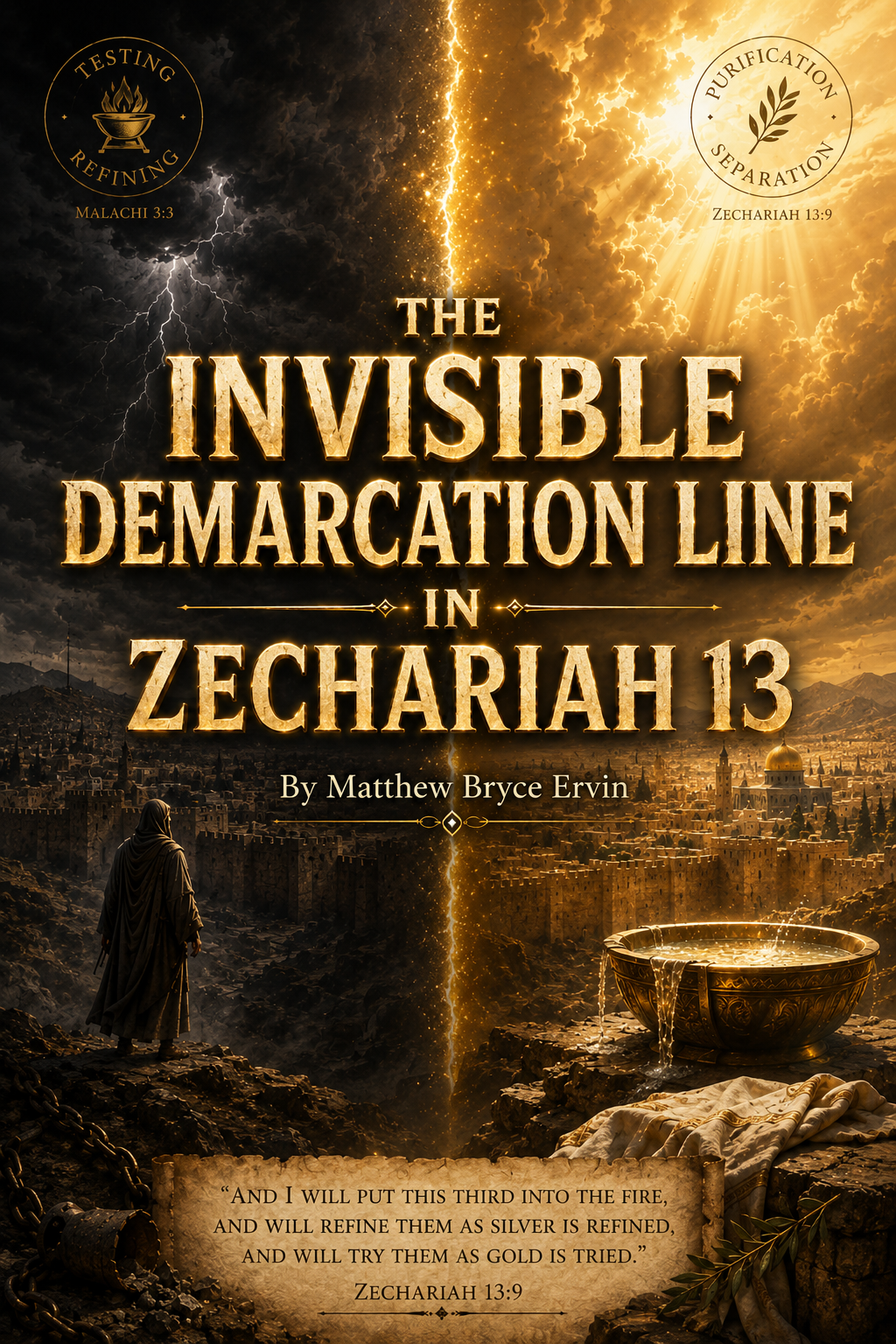
The Invisible Demarcation Line in Zechariah 13
- Authors
-
-
Matthew Bryce Ervin
Author
-
- Abstract
-
The first six verses of Zechariah 13 are written in prose. The structure suddenly shifts to poetry with verse 7. This creates an invisible demarcation line of sorts between verses 6 and 7. As much of the Old Testament is written in poetry, this demarcation line would not be especially remarkable. However, the purposes for shifting from prose to poetry can be for more than just adding heightened emotion and memorable phrasing. In this case, the shift suggests that the Shepherd, who is YHWH’s Associate in verse 7, is meant to be differentiated from the false prophet (or prophets) discussed in verses 4–6. Making such a distinction is necessary to avoid common conflations, thereby helping us to better understand the chapter and related passages.
- Author Biography
- References
-
Boda, Mark J. The Book of Zechariah. New International Commentary on the Old Testament. Grand Rapids, MI: Eerdmans, 2016.
The Complete Tanakh (Tanach) With Rashi’s Commentary. Rashi’s Commentary Translated by Rabbi A.J. Rosenberg. Chabad, 2026. https://www.chabad.org/library/bible_cdo/aid/63255/jewish/The-Bible-with-Rashi.htm
Feinberg, Charles. “Zechariah.” In The Wycliffe Bible Commentary, edited by Charles Pfeiffer and Everett Harrison, 2001. Chicago: Moody, 1962.
Henry, Matthew. Matthew Henry’s Concise Commentary on the Bible. Grand Rapids, MI: Christian Classics Ethereal Library, 2010.
Kimchi, David. Rabbi David Kimchi’s Commentary Upon the Prophecies of Zechariah. Translated by Alexander McCaul. London: James Duncan, 1837.
Klein, George L. Zechariah. New American Commentary. Nashville, TN: B&H Publishing Group, 2008.
Meyers, Carol L., and Eric M. Meyers. Zechariah 9–14: A New Translation with Introduction and Commentary. Anchor Bible 25C. New York: Doubleday, 1993.
The NET Bible Full-notes Edition Notes. Nashville, TN: Thomas Nelson, 2019.
Petersen, David L. Zechariah 9–14 & Malachi: A Commentary. Louisville, KY: Westminster John Knox Press, 1995.
Phillips, Richard D. Zechariah. Reformed Expository Commentary. Phillipsburg, NJ: P&R Publishing, 2007.
Pusey, Edward B. The Minor Prophets: Micah, Nahum, Habakkuk, Zephaniah, Haggai, Zechariah and Malachi. New York: Funk & Wagnalls, 1885.
Rydelnik, Michael, and Edwin Blum, eds. The Moody Handbook of Messianic Prophecy: Studies and Expositions of the Messiah in the Old Testament. Chicago: Moody Publishers, 2019.
Spence-Jones, Henry D. M. The Pulpit Commentary. Vol. 32. New York: Funk & Wagnalls, 1889.
Unger, Merril F. Zechariah: Prophet of Messiah’s Glory. Eugene, OR: Wipf and Stock, 2014.
Webb, Barry G. The Message of Zechariah: Your Kingdom Come. The Bible Speaks Today. Downers Grove, IL: InterVarsity Press, 2003.
- Cover Image
-
- Downloads
- Published
- 2026-07-07
- Section
- Articles