
The Clock That Should Not Exist
- Authors
-
-
M. Nailor
Author
-
- Abstract
-
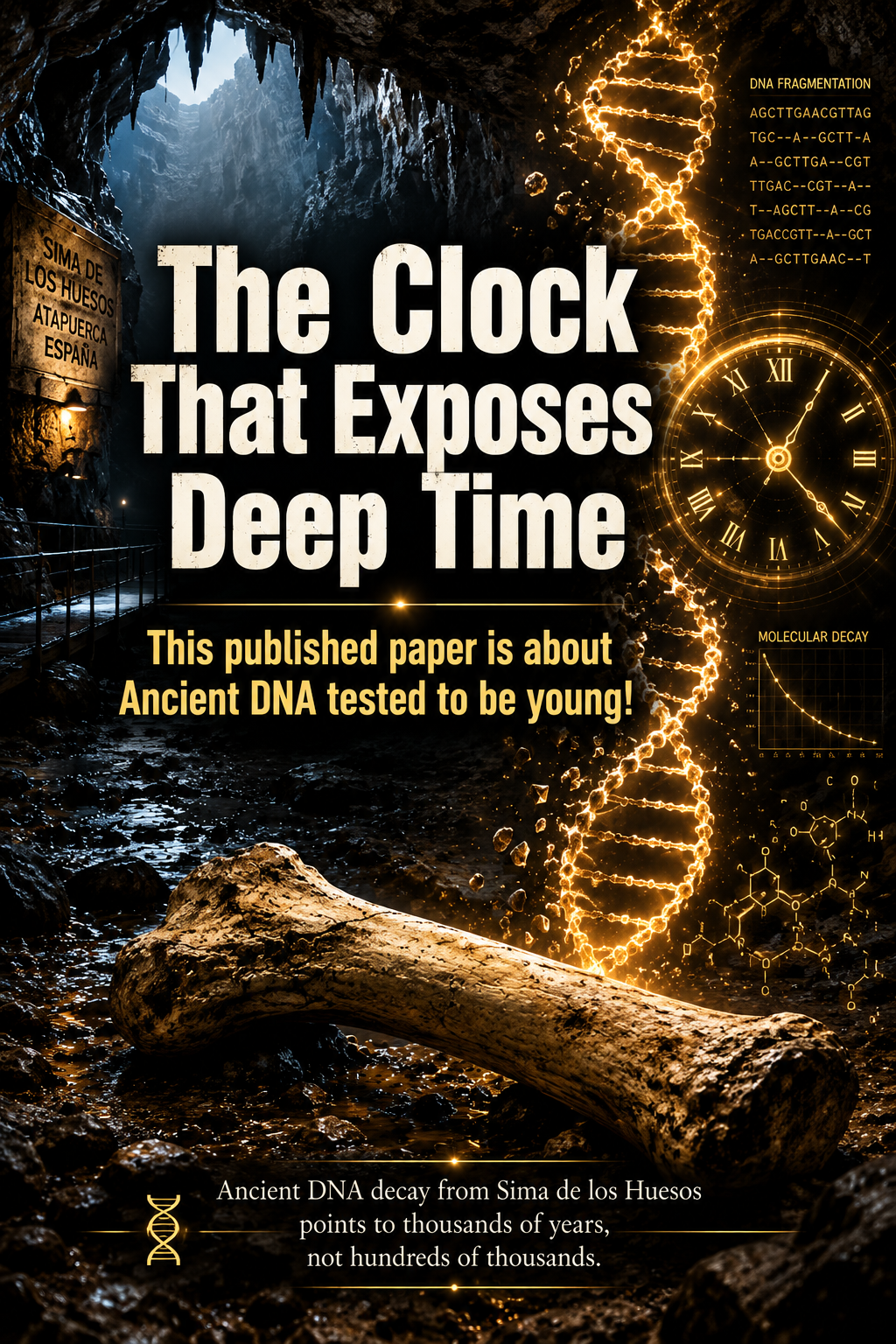
DNA is not a stable molecule. From the moment cellular repair ceases at death, it breaks down through four measurable chemical pathways, dominated by hydrolytic depurination, whose temperature dependence follows the Arrhenius law with high precision. This means that for any specimen of known burial temperature, the surviving fragment length is a clock that can be read directly, independent of the geological dating framework. I apply the most rigorous directly observed decay rate available, the moa bone kinetics of Allentoft et al. (2012), to the famous Sima de los Huesos hominin femur from Atapuerca, Spain, a specimen conventionally assigned an age of approximately 430,000 years yet recovered from a cool, wet, non-frozen cave averaging 10.6°C. Researchers themselves describe this specimen as the only non-permafrost site on Earth preserving Middle Pleistocene DNA, an explicit admission that it violates every other observed survival limit. Reading the clock forward, I predict that the observed fragmentation state, fragments capped near 45 bp with a mode near 30 bp, corresponds to a true postmortem interval on the order of thousands of years, not hundreds of thousands. My central reading combines the two conditions the cave actually has, its seasonal temperature cycle and its poorer-than-average preservation, into a single effective rate of 6.194 × 10⁻⁶ per nucleotide per year. That rate places the burial at a midpoint near 4,485 years, with a 30 bp reading of about 5,350 years and a 45 bp youngest-bound of about 3,570 years, squarely within the post-Flood window. The simpler single-factor scenarios bound this between roughly 5,261 and 8,342 years; every one is thousands of years, not hundreds of thousands. I show that survival to 430,000 years at this fragment length would require a sustained burial temperature near negative 9.8°C, which the cave has never provided. Under the assumptions of the observed decay model, the measured fragment lengths are inconsistent with the published geological age and rather align with the biblical timeline.
- Author Biography
- References
-
Allentoft, M. E., Collins, M., Harker, D., Haile, J., Oskam, C. L., Hale, M. L., et al. (2012). The half-life of DNA in bone: measuring decay kinetics in 158 dated fossils. Proceedings of the Royal Society B, 279(1748), 4724–4733.
Lindahl, T. (1993). Instability and decay of the primary structure of DNA. Nature, 362(6422), 709–715.
Meyer, M., Arsuaga, J.-L., de Filippo, C., Nagel, S., Aximu-Petri, A., Nickel, B., et al. (2016). Nuclear DNA sequences from the Middle Pleistocene Sima de los Huesos hominins. Nature, 531(7595), 504–507.
Meyer, M., Fu, Q., Aximu-Petri, A., Glocke, I., Nickel, B., Arsuaga, J.-L., et al. (2014). A mitochondrial genome sequence of a hominin from Sima de los Huesos. Nature, 505(7483), 403–406.
Arsuaga, J. L., Martínez, I., Arnold, L. J., Aranburu, A., Gracia-Téllez, A., Sharp, W. D., et al. (2014). Neandertal roots: Cranial and chronological evidence from Sima de los Huesos. Science, 344(6190), 1358–1363.
- Cover Image
-
- Downloads
- Published
- 2026-07-07
- Section
- Articles
- Categories
Most read articles by the same author(s)
- M. Nailor, D. Budinsky, Predictions Under Trial: A Comparative Analysis of Creation and Evolutionary Predictions and Expectations , Truth in Research: Vol. 1 No. 1 (2026): Truth in Research: Foundations of Scientific Inquiry
- D. Budinsky, M. Nailor, The Hidden Clock of Humanity: A pedigree-based coalescence and fixation analysis of the human mitochondrial control region , Truth in Research: Vol. 1 No. 1 (2026): Truth in Research: Foundations of Scientific Inquiry
- M. Nailor, Carved in Stone Across the World: A Global Catalog of Sauropod Type Dinosaur Depictions in Human Art and a Probability Assessment of Depicting a Creature Never Seen , Truth in Research: Vol. 1 No. 1 (2026): Truth in Research: Foundations of Scientific Inquiry
- M. Nailor, One Ancestral Hominin Lineage Across Modern and Archaic Homo , Truth in Research: Vol. 1 No. 1 (2026): Truth in Research: Foundations of Scientific Inquiry
- D. Budinsky, M. Nailor, Predicted Continuity, Observed Discontinuity: Ape Y Chromosome Architecture as a Test of Bounded Diversity , Truth in Research: Vol. 1 No. 1 (2026): Truth in Research: Foundations of Scientific Inquiry
- D. Budinsky, M. Nailor, Unmasking the Genome: The End of Junk DNA , Truth in Research: Vol. 1 No. 1 (2026): Truth in Research: Foundations of Scientific Inquiry
- M. Nailor, Mineralization Rate in Vertebrate Fossilization Is Condition-Limited, Not Time-Limited , Truth in Research: Vol. 1 No. 3 (2026): Scientific Research and Discovery
- Décima Oneto, C, Coronel, J., Storani, L., M. Nailor, Feingold, S., Gonzalez M. N., Massa, G. A., Efficient Transformation of Solanum tuberosum cv. Spunta Mediated by Agrobacterium tumefaciens Using Hygromycin as a Selective Agent , Truth in Research: Vol. 1 No. 3 (2026): Scientific Research and Discovery
- Bergman J., D. Budinsky, M. Nailor, Does Simple Clumping Explain the Origin of Multicellularity? , Truth in Research: Vol. 1 No. 1 (2026): Truth in Research: Foundations of Scientific Inquiry
- M. Nailor, How Much Leucine After Fifty? , Truth in Research: Vol. 1 No. 3 (2026): Scientific Research and Discovery