
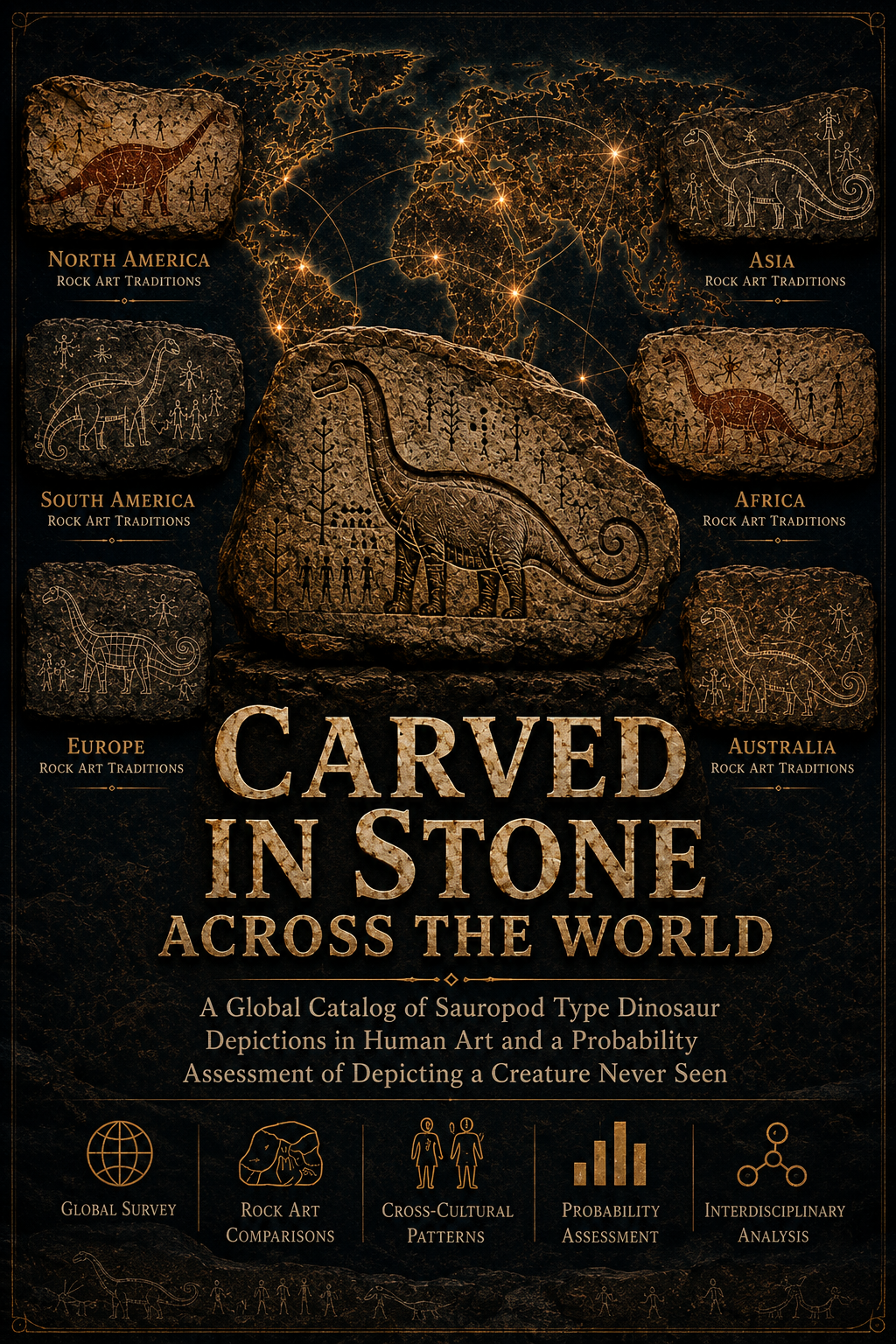
Carved in Stone Across the World
A Global Catalog of Sauropod Type Dinosaur Depictions in Human Art and a Probability Assessment of Depicting a Creature Never Seen
- Authors
-
-
M. Nailor
Author
-
- Abstract
-
Scattered across the world, in places whose builders had no demonstrated contact with one another, are works of human art that resemble long necked, long tailed quadrupedal animals of the kind paleontologists call sauropods, along with many other dinosaur-like forms. This paper does three things. First, it assembles just some of these depictions, specifically focusing on sauropod themed artwork into a single catalog with their verifiable locations, the case made by those who read them as dinosaurs, and the case made by those who do not. Second, it takes a look at the statistical probability that such a catalog of similar art naturally arises. Across human cultures, art overwhelmingly depicts animals the artists had actually seen, so what is the prior probability that widely separated peoples independently produced anatomically specific images of a creature none of them ever encountered? I express this as a Bayesian relation, identify the single term on which the whole inference turns, and show honestly which of the cataloged examples strengthen the case and which, including two known forgeries, do not. The conclusion of this catalog is deliberately cautious. It does not rely on weak examples, modern forgeries, or vague animal shapes. Rather, the argument is that when those weaker cases are removed, a smaller but more significant residue remains: depictions from widely separated parts of the world that appear to show a recurring and specific anatomy. Where these images cannot be easily explained by simple shape coincidence, fossil-inspired imagination, or fraud, the probability of pure coincidence is lowered enough that the evidence deserves a serious answer. The difficulty is that such an answer is rarely given, because the dominant secular framework does not allow the possibility that humans may have actually witnessed animals now classified as dinosaurs. As a result, even when physical evidence appears to sit directly in front of us, the explanation is often forced into categories such as myth, mistake, coincidence, or fraud before the evidence is allowed to speak on its own terms. This catalog challenges that approach by asking a simple question: after the weak examples are filtered out, do the strongest remaining depictions still deserve to be dismissed, or do they point to something the standard framework is unwilling to consider?
- Author Biography
- References
-
References
Senter, P., & Cole, S. J. (2011). “Dinosaur” petroglyphs at Kachina Bridge site, Natural Bridges National Monument, southeastern Utah: Not dinosaurs after all. Palaeontologia Electronica, 14(1), 2A.
Doyle, S. (2016). Ica stones, Acámbaro figurines, and good arguments. Creation Ministries International.
DiPeso, C. C. (1953). The clay figurines of Acámbaro, Guanajuato, Mexico. American Antiquity, 18(4), 388–389.
Mayor, A. (2000). The First Fossil Hunters: Paleontology in Greek and Roman Times. Princeton University Press.
Witton, M. P., & Hing, R. A. (2024). Did the horned dinosaur Protoceratops inspire the griffin? Interdisciplinary Science Reviews. (Argues against the fossil inspiration link.)
Dong, Z., Peng, G., & Huang, D. (1989). The discovery of the bony tail club of sauropods. Vertebrata PalAsiatica, 27(3), 219–224.
UNESCO World Heritage Centre. Tassili n'Ajjer (listing and description of the rock art and its documented fauna).
- Cover Image
-
- Downloads
- Published
- 2026-06-28
- Section
- Articles
- Categories
- License
-
Copyright (c) 2026 Author(s) retain copyright and articles are published under CC BY 4.0.

This work is licensed under a Creative Commons Attribution 4.0 International License.

Most read articles by the same author(s)
- M. Nailor, D. Budinsky, Predictions Under Trial: A Comparative Analysis of Creation and Evolutionary Predictions and Expectations , Truth in Research: Vol. 1 No. 1 (2026): Truth in Research: Foundations of Scientific Inquiry
- D. Budinsky, M. Nailor, The Hidden Clock of Humanity: A pedigree-based coalescence and fixation analysis of the human mitochondrial control region , Truth in Research: Vol. 1 No. 1 (2026): Truth in Research: Foundations of Scientific Inquiry
- M. Nailor, One Ancestral Hominin Lineage Across Modern and Archaic Homo , Truth in Research: Vol. 1 No. 1 (2026): Truth in Research: Foundations of Scientific Inquiry
- M. Nailor, The Clock That Should Not Exist , Truth in Research: Vol. 1 No. 1 (2026): Truth in Research: Foundations of Scientific Inquiry
- D. Budinsky, M. Nailor, Predicted Continuity, Observed Discontinuity: Ape Y Chromosome Architecture as a Test of Bounded Diversity , Truth in Research: Vol. 1 No. 1 (2026): Truth in Research: Foundations of Scientific Inquiry
- D. Budinsky, M. Nailor, Unmasking the Genome: The End of Junk DNA , Truth in Research: Vol. 1 No. 1 (2026): Truth in Research: Foundations of Scientific Inquiry
- M. Nailor, Mineralization Rate in Vertebrate Fossilization Is Condition-Limited, Not Time-Limited , Truth in Research: Vol. 1 No. 3 (2026): Scientific Research and Discovery
- M. Nailor, How Much Leucine After Fifty? , Truth in Research: Vol. 1 No. 3 (2026): Scientific Research and Discovery
- Bergman J., D. Budinsky, M. Nailor, Does Simple Clumping Explain the Origin of Multicellularity? , Truth in Research: Vol. 1 No. 1 (2026): Truth in Research: Foundations of Scientific Inquiry
- M. Nailor, Mud Problem Exposed , Truth in Research: Vol. 1 No. 1 (2026): Truth in Research: Foundations of Scientific Inquiry