
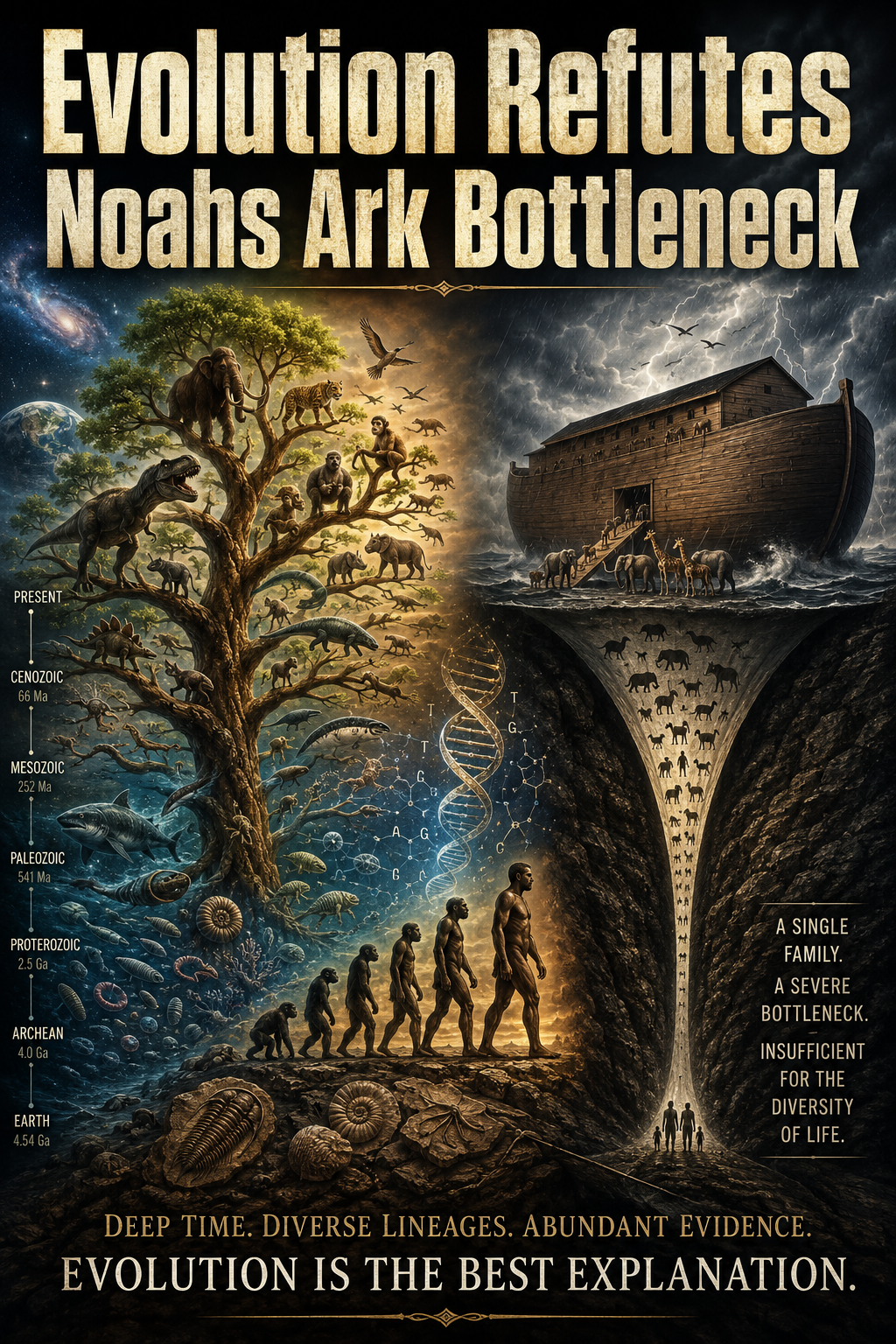
Evolution and the Single-Pair Bottleneck
- Authors
-
-
Anderw Skow
Author
-
- Abstract
-
The flood narrative in Genesis records that most terrestrial animals boarded the ark as single breeding pairs, with a smaller set of clean animals boarding in sevens. Read literally, this places nearly every living terrestrial lineage through a founding event of one diploid pair roughly 4,500 years ago, followed by dispersal from a single region, the mountains of Ararat in the Middle East, in what is now Turkey. This paper evaluates that scenario against two well established bodies of population genetics: the genetics of small and inbred populations, and the theory of founder effects during range expansion. An effective size of about two produces severe and predictable consequences, rising inbreeding, loss of genetic variation, and a risk of mutational meltdown. A single geographic origin further predicts a radial decline of genetic diversity away from the point of release and a nested, serial founder structure centered on the mountains of Ararat. The observed distribution of terrestrial diversity does not show this pattern; it shows deep, geographically structured radiations and coalescence times that greatly exceed a few thousand years. I close by stating two falsifiable challenges that a literal ark model must meet: to demonstrate the founder effect and inbreeding signatures of a recent single pair bottleneck, and to demonstrate the expected radiation outward from the region where the ark is said to have come to rest.
- Author Biography
- References
-
Avise, J. C. (2000). Phylogeography: The History and Formation of Species. Cambridge, MA: Harvard University Press.
Charlesworth, D., & Charlesworth, B. (1987). Inbreeding depression and its evolutionary consequences. Annual Review of Ecology and Systematics, 18, 237–268.
Frankham, R. (1996). Relationship of genetic variation to population size in wildlife. Conservation Biology, 10(6), 1500–1508.
Hedrick, P. W., & Kalinowski, S. T. (2000). Inbreeding depression in conservation biology. Annual Review of Ecology and Systematics, 31, 139–162.
Hewitt, G. M. (2000). The genetic legacy of the Quaternary ice ages. Nature, 405, 907–913.
Keller, L. F., & Waller, D. M. (2002). Inbreeding effects in wild populations. Trends in Ecology & Evolution, 17(5), 230–241.
Lynch, M., Conery, J., & Bürger, R. (1995). Mutational meltdowns in sexual populations. Evolution, 49(6), 1067–1080.
Spielman, D., Brook, B. W., & Frankham, R. (2004). Most species are not driven to extinction before genetic factors impact them. Proceedings of the National Academy of Sciences, 101(42), 15261–15264.
- Cover Image
-
- Downloads
- Published
- 2026-07-12
- Section
- Articles
- Categories
Most read articles by the same author(s)
- Andrew Skow, Nanowarming: Using Molecular Nanotechnology to Make Organ Banking Possible , Truth in Research: Vol. 1 No. 3 (2026): Scientific Research and Discovery