
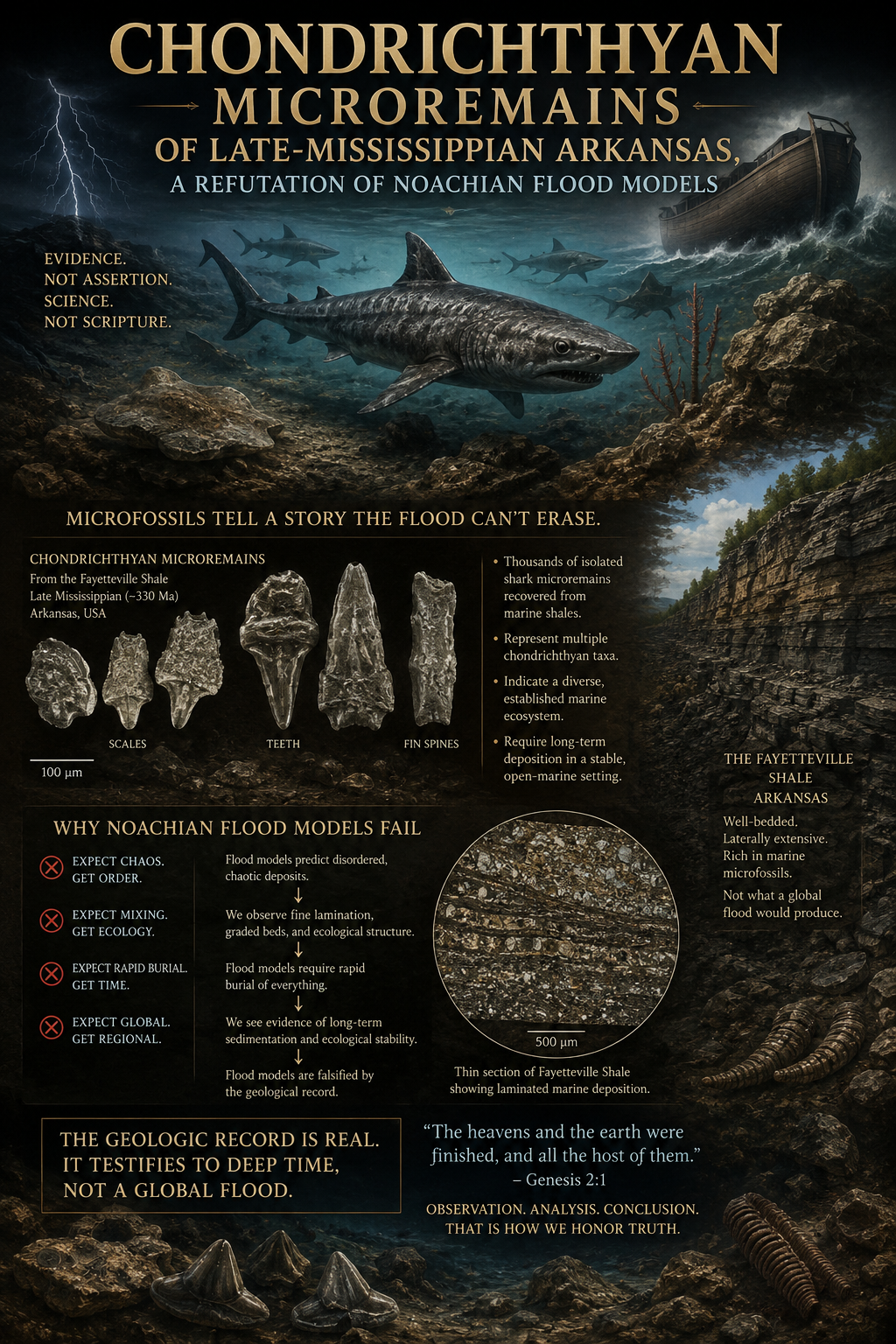
Chondrichthyan Microremains of Late-Mississippian Arkansas, a Refutation of Noachian Flood Models
- Authors
-
-
Jackson Roe
Author
-
- Abstract
-
Specimens of Chondrichthyan teeth and denticles were recovered from the Carboniferous Pitkin formation of Arkansas by dissolving samples of limestone. Many taxa were identified from the samples, but no anatomically modern species could be located in any sample group. Creationist models of fossil distribution are discussed and found to be insufficient to explain the fossil record, especially in the context of microscopic Chondrichthyan remains of the Carboniferous period. Modern shark denticles and teeth are also compared to the samples found in this study. Hydrological sorting and ecological zonation simply do not appear to be adequate hypotheses for explaining these findings. Creationists are urged to find a hypothesis that better explains the microfossil Chondrichthy.
- Author Biography
- References
-
Sansom, I., Smith, M. & Smith, M. Scales of thelodont and shark-like fishes from the Ordovician of Colorado. Nature 379, 628–630 (1996). https://doi.org/10.1038/379628a0
Julien M. Claes, Keiichi Sato, Jérôme Mallefet, Morphology and control of photogenic structures in a rare dwarf pelagic lantern shark (Etmopterus splendidus), Journal of Experimental Marine Biology and Ecology, Volume 406, Issues 1–2, 2011, Pages 1-5, ISSN 0022-0981, https://doi.org/10.1016/j.jembe.2011.05.033.
Battiata, M.; Serena, F.; Lo Brutto, S. Genetic and Distribution Data of the Bramble Shark Echinorhinus brucus(Bonnaterre, 1788) and the Prickly Shark Echinorhinus cookei Pietschmann, 1928 to Better Reconstruct Their Conservation Status. Animals 2024, 14, 993. https://doi.org/10.3390/ani14070993
Hodnett J-PM, Elliott DK. Carboniferous chondrichthyan assemblages from the Surprise Canyon and Watahomigi formations (latest Mississippian–Early Pennsylvanian) of the western Grand Canyon, Northern Arizona. Journal of Paleontology. 2018;92(S77):1-33. doi:10.1017/jpa.2018.72
Ginter, M. and Sun, Y. 2007. Chondrichthyan remains from the Lower Carboniferous of Muhua, southern China. Acta Palaeontologica Polonica 52 (4): 705–727.
Ginter, M. and Złotnik, M. 2019. Mississippian chondrichthyan fishes from the area of Krzeszowice, southern Poland. Acta Palaeontologica Polonica 64 (3): 549–564.
- Cover Image
-
- Downloads
- Published
- 2026-08-05
- Section
- Articles
- Categories
- License
-
Copyright (c) 2026 Author(s) retain copyright and articles are published under CC BY 4.0.

This work is licensed under a Creative Commons Attribution 4.0 International License.
