
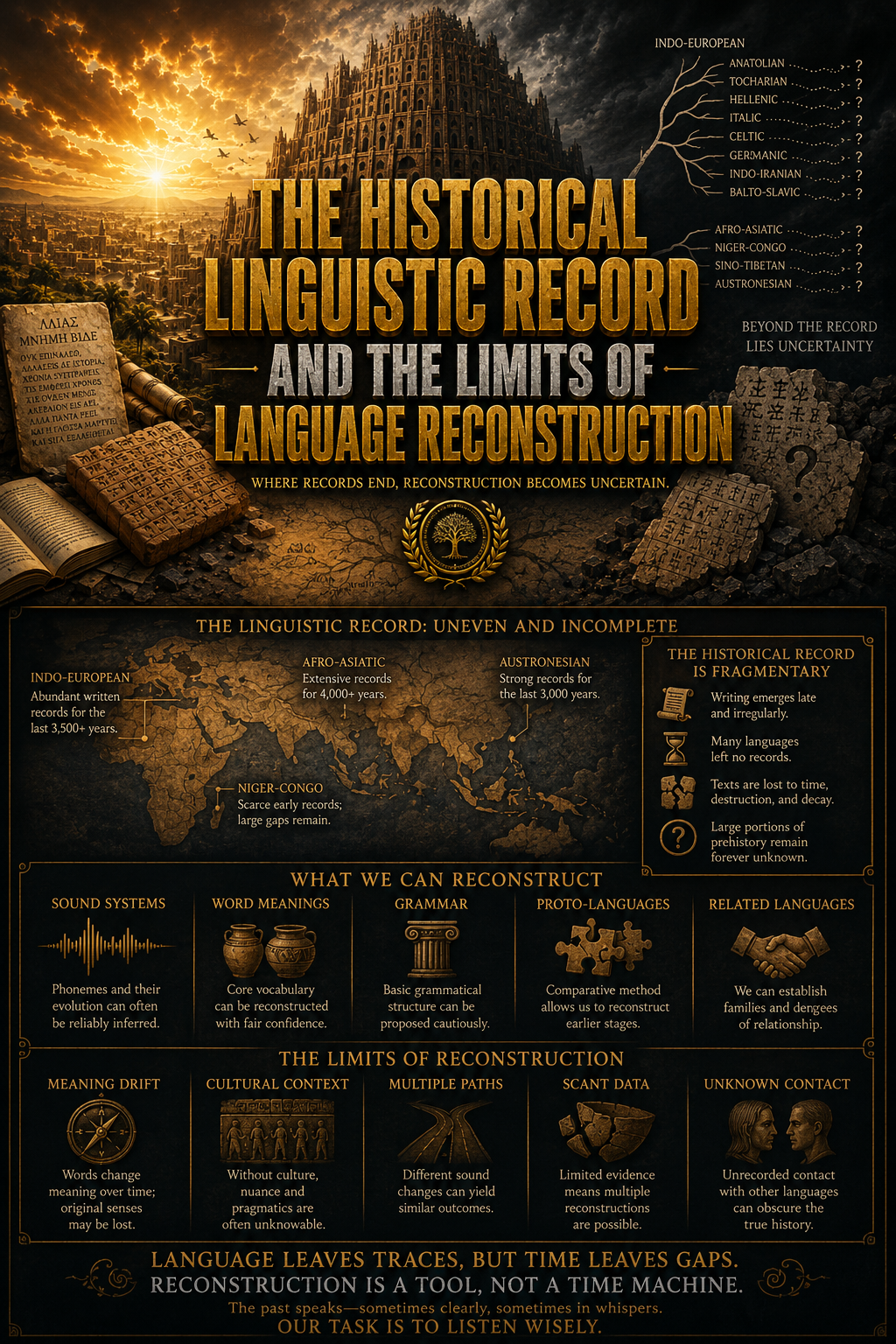
The Historical Linguistic Record and the Limits of Language Reconstruction
- Authors
-
-
Jessi Warthen
Author
-
- Abstract
-
This paper evaluates the origin of human linguistic diversity by holding the biblical account of Babel and the secular model of gradual linguistic evolution to a single evidentiary standard: documented data rather than extrapolated estimate. Working only from confirmed counts in the Ethnologue and Glottolog databases, it establishes a conservative baseline of roughly 8,000 documented languages and observes that confirmed language isolates approach or exceed one third of all language families, a proportion poorly predicted by gradual divergence from a common ancestral tongue. A population model derived from the Genesis genealogies, applying a fertility parameter drawn directly from the Table of Nations, yields approximately 800 male heads of family present at Babel and a resulting ratio near ten documented languages per original group, a rate consistent with observable diversification in known families such as Indo-European. The persistence of unrelated isolates, including Basque and Sumerian, together with the documented universality of flood accounts among geographically isolated populations such as the Selk'nam, Jarawa, and Inuit, supplies independent lines of evidence that converge on a single dispersal event. When admitted as a live hypothesis and tested against documented data, the biblical model performs more consistently on this body of evidence than a secular alternative reliant on undocumented prehistoric language counts and diffusion mechanisms that fail precisely where the evidence is most isolated.
- Author Biography
- References
-
Campbell, L. (Ed.). (2018). Language isolates. Routledge.
Eberhard, D. M., Simons, G. F., & Fennig, C. D. (Eds.). (2025). Ethnologue: Languages of the world (28th ed.). SIL International. https://www.ethnologue.com
Hammarström, H., Forkel, R., Haspelmath, M., & Bank, S. (2025). Glottolog 5.3. Max Planck Institute for Evolutionary Anthropology. https://glottolog.org
International Organization for Standardization. (2007). ISO 639-3:2007. Codes for the representation of names of languages: Part 3, Alpha-3 code for comprehensive coverage of languages. ISO.
Jeanson, N. T. (2022). Traced: Human DNA’s big surprise. Master Books.
Vennemann, T. (2003). Europa Vasconica – Europa Semitica (P. Noel Aziz Hanna, Ed.). Mouton de Gruyter.
Witzel, M. E. J. (2010). Pan-Gaean flood myths: Gondwana myths and beyond. In W. M. J. van Binsbergen & E. Venbrux (Eds.), New perspectives on myth: Proceedings of the Second Annual Conference of the International Association for Comparative Mythology (pp. 225–242). Shikanda.
- Cover Image
-
- Downloads
- Published
- 2026-06-30
- Section
- Articles
- Categories