
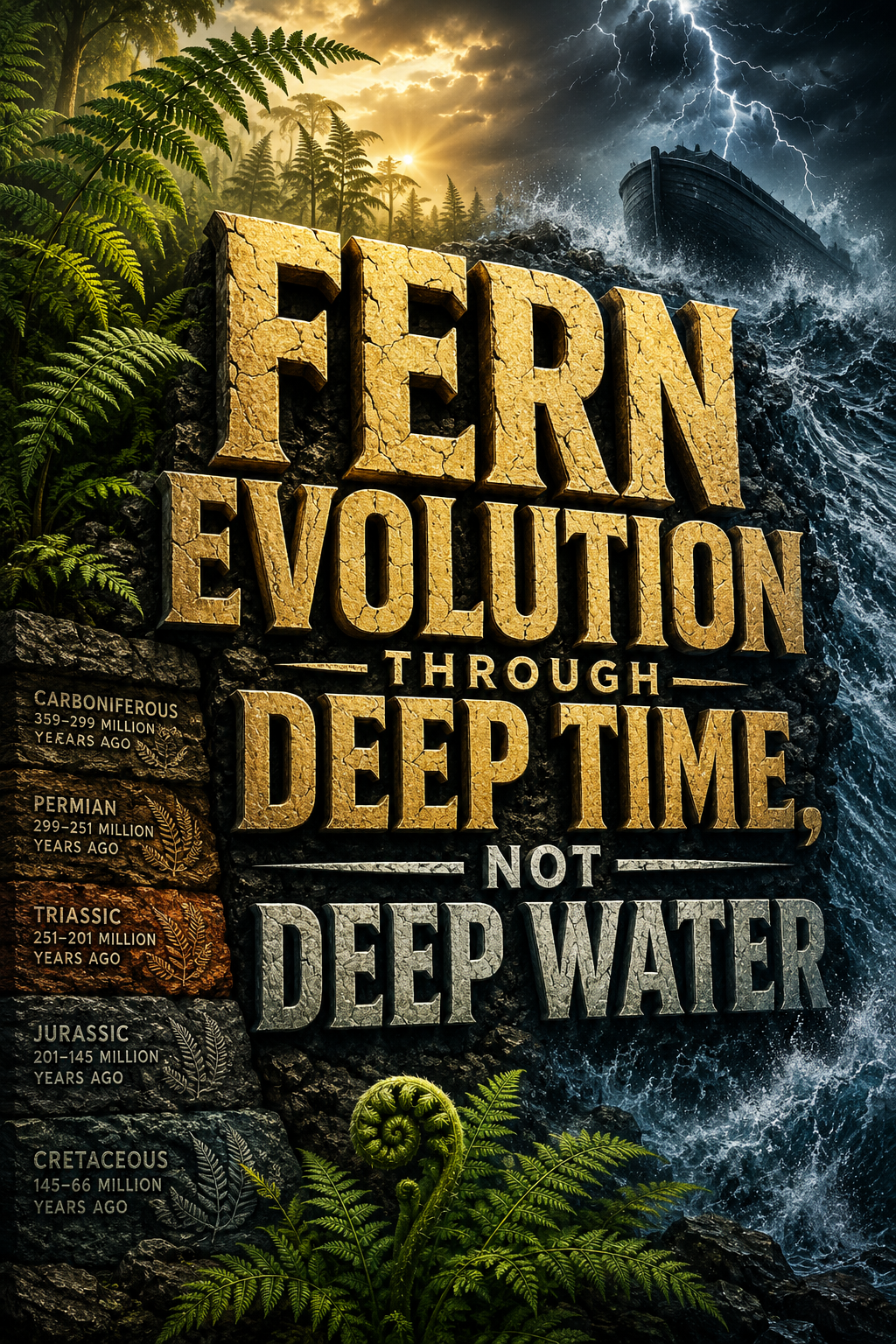
Fern Evolution Through Deep Time, Not Deep Water
- Authors
-
-
James Pagatpat
Author
-
- Abstract
-
The global Flood account requires that the present diversity of land plants re-established after roughly one year of inundation. Seed plants have an obvious survival route, since they can persist and travel as seeds, and the ark narrative concerns food, which Genesis elsewhere identifies with seed-bearing plants (Genesis 1:11-12; 1:29; 6:21). Ferns, however, are seedless. They reproduce through wind-dispersed spores and a small, free-living gametophyte, and if they were not carried as propagules in the manner of seed plants, their persistence through the Flood must have depended on spores surviving in the water column, in bottom sediments, or on floating debris. I examine this requirement against the only experimental study to test fern spore survival under prolonged saline and freshwater inundation (de Groot and During, 2013). That study found that immersion in freshwater alone was tolerated by most tested species, but that salt progressively reduced germination, and that gametophytes grown from spores held for a year in saline water were smaller and far less viable. Critically, real marine sediments yielded no viable fern spores, and freshwater sediments yielded only two gametophytes, both of which died before maturity. Because a global Flood would be predominantly marine and more saline than the conditions tested, and because it would leave no dry refugia from which fresh spores could re-seed the drained land, sediment-based fern survival appears far from optimal. I then set this against the paleobotanical record, which shows a long and continuous fern diversification with no signature of a recent global bottleneck. I conclude that the survival of ferns is a genuine difficulty for a literal global year-long Flood.
- Author Biography
- References
-
Christenhusz, M. J. M., and Chase, M. W. (2014). Trends and concepts in fern classification. Annals of Botany 113: 571-594.
Copeland, E. B. (1958-1960). Fern Flora of the Philippines, Volumes 1-3. Manila: Bureau of Printing.
de Groot, G. A., and During, H. J. (2013). Fern spore longevity in saline water: can sea bottom sediments maintain a
viable spore bank? PLoS ONE 8(11): e79470. https://doi.org/10.1371/journal.pone.0079470
Dyer, A. F. (1994). Natural soil spore banks, can they be used to retrieve lost ferns? Biodiversity and Conservation
3: 160-175.
Dyer, A. F., and Lindsay, S. (1992). Soil spore banks of temperate ferns. American Fern Journal 82: 89-123.
Pangua, E., Belmonte, R., and Pajaron, S. (2009). Germination and reproductive biology in salty conditions of Asplenium marinum (Aspleniaceae), a European coastal fern. Flora 204: 673-684.
Pelser, P. B., Barcelona, J. F., and Nickrent, D. L. (eds.) (2011 onwards). Co's Digital Flora of the Philippines. www.philippineplants.org.
PPG I (The Pteridophyte Phylogeny Group) (2016). A community-derived classification for extant lycophytes and ferns. Journal of Systematics and Evolution 54: 563-603.
Pryer, K. M., Schuettpelz, E., Wolf, P. G., Schneider, H., Smith, A. R., and Cranfill, R. (2004). Phylogeny and evolution of ferns (monilophytes) with a focus on the early leptosporangiate divergences. American Journal of Botany 91: 1582-1598.
Quintanilla, L. G., Amigo, J., Pangua, E., and Pajaron, S. (2002). Effect of storage method on spore viability in five globally threatened fern species. Annals of Botany 90: 461-467.
Schuettpelz, E., and Pryer, K. M. (2009). Evidence for a Cenozoic radiation of ferns in an angiosperm-dominated canopy. Proceedings of the National Academy of Sciences 106(27): 11200-11205.
Smith, A. R., Pryer, K. M., Schuettpelz, E., Korall, P., Schneider, H., and Wolf, P. G. (2006). A classification for extant ferns. Taxon 55: 705-731.
Sun, W. Q., Li, X. P., and Ong, B. L. (1999). Preferential accumulation of D-pinitol in Acrostichum aureum gametophytes in response to salt stress. Physiologia Plantarum 105: 51-57.
Scripture citations are to the Book of Genesis (1:11-12; 1:29; 6:19-21; 7:11-12; 8:13-14).
- Cover Image
-
- Downloads
- Published
- 2026-08-08
- Section
- Articles
- Categories
- License
-
Copyright (c) 2026 Author(s) retain copyright and articles are published under CC BY 4.0.

This work is licensed under a Creative Commons Attribution 4.0 International License.
