
Sacred Geometry Across Civilizations
- Authors
-
-
Robert Sorta
Author
-
- Abstract
-
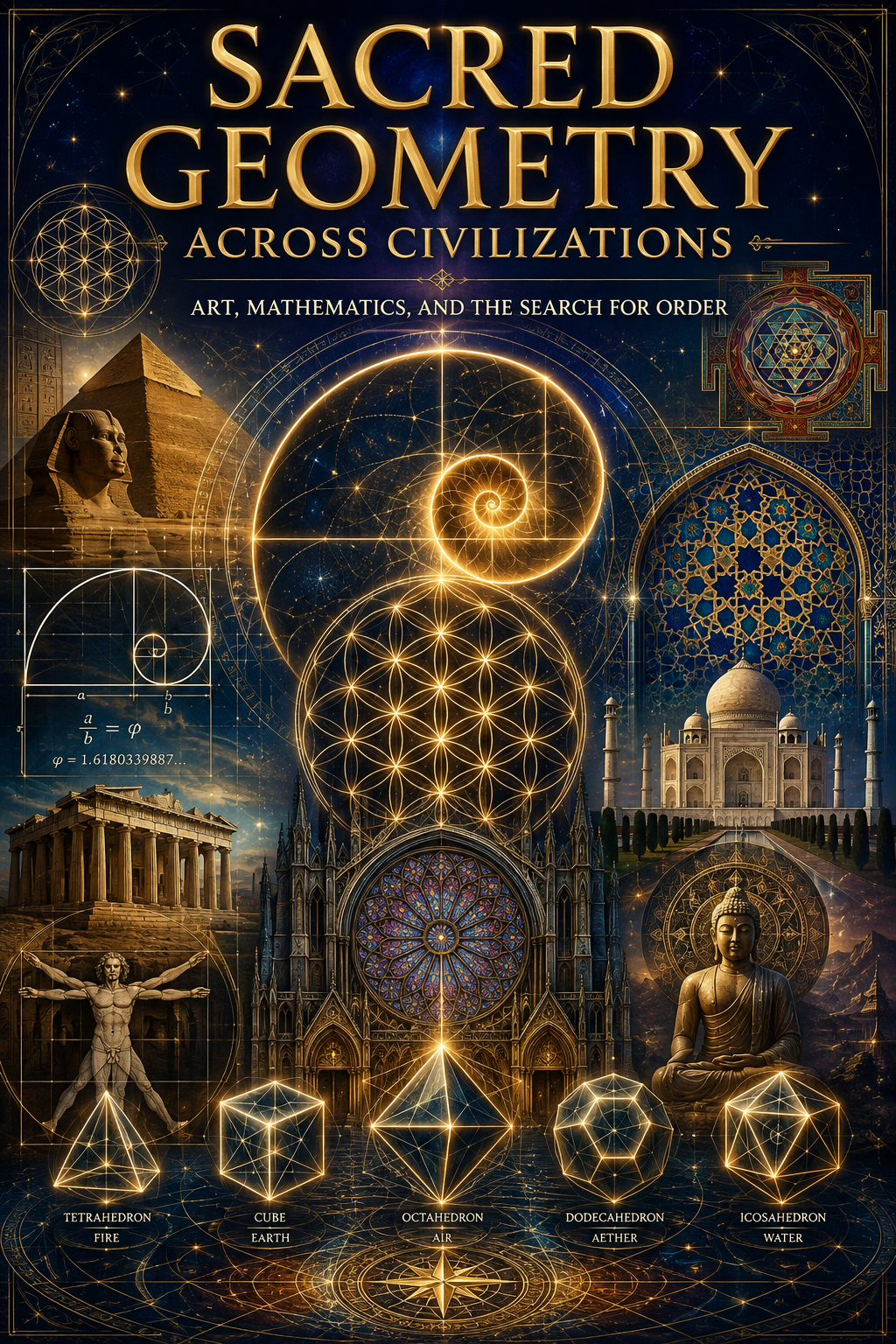
Across civilizations, mathematical order has repeatedly become more than a construction method. Circles, squares, axial plans, modular ratios, radial diagrams, star polygons, and repeating fields have been used to make temples, mosques, cathedrals, manuscripts, pavements, mandalas, and civic monuments intelligible as images of cosmic or divine order. This recurrence invites a difficult question: does beauty contain objective patterns, or do cultures teach viewers what to admire? This paper combines art history, mathematics, empirical aesthetics, and neuroaesthetics to argue for constrained pluralism. Human visual systems rapidly detect regularity, especially reflectional symmetry, grouping, repetition, contrast, and coherent scale relations. Such properties can increase processing fluency, reduce uncertainty, and create reliable starting biases. Yet a detectable structure is not an irresistible law of beauty. Complexity preferences vary across individuals and cultures, color harmony depends on learned associations and context, expertise can transform difficulty into interest, and the golden ratio has no demonstrated status as a universal aesthetic constant. Historical evidence likewise shows several proportional grammars rather than one hidden code. A new Constraint and Consecration Model is proposed. It separates perceptual constraint, learned calibration, and symbolic consecration while explaining how they interact in sacred art. Geometry becomes transcendent not because the brain contains a single divine ratio detector, but because ordered forms make relations visible, support prediction, compress complexity, coordinate collective attention, and receive culturally authoritative meanings. The strongest conclusion is therefore neither strict objectivism nor cultural relativism. Aesthetic response is patterned, embodied, learnable, and historically interpreted.
- Author Biography
- References
-
Ackerman, J. S. (1949). Ars sine scientia nihil est, Gothic theory of architecture at the Cathedral of Milan. The Art Bulletin, 31(2), 84,111. Source
Berlyne, D. E. (1971). Aesthetics and psychobiology. Appleton Century Crofts.
Bertamini, M., Rampone, G., Oulton, J., Tatlidil, S., and Makin, A. D. J. (2019). Sustained response to symmetry in
extrastriate areas after stimulus offset, an EEG study. Scientific Reports, 9, 4401. Source
Bork, R. (2014). The geometry of Bourges Cathedral. Architectural Histories, 2(1), Article 24. Source
Brauen, M. (1997). The mandala, Sacred circle in Tibetan Buddhism. Shambhala.
Ceriani Sebregondi, G., and Schofield, R. (2016). First principles, Gabriele Stornaloco and Milan Cathedral. Architectural
History, 59, 63,122. Source
Chatterjee, A., and Vartanian, O. (2014). Neuroaesthetics. Trends in Cognitive Sciences, 18(7), 370,375. Source
Che, J., Sun, X., Gallardo, V., and Nadal, M. (2018). Cross cultural empirical aesthetics. Progress in Brain Research, 237, 77,103. Source
Department of Islamic Art. (2001). Geometric patterns in Islamic art. The Metropolitan Museum of Art. Source
Graf, L. K. M., and Landwehr, J. R. (2015). A dual process perspective on fluency based aesthetics, The pleasure interest
model of aesthetic liking. Personality and Social Psychology Review, 19(4), 395,410. Source
Green, C. D. (1995). All that glitters, A review of psychological research on the aesthetics of the golden section. Perception,
24(8), 937,968. Source
Grünbaum, B., and Shephard, G. C. (1987). Tilings and patterns. W. H. Freeman.
Güçlütürk, Y., Jacobs, R. H. A. H., and van Lier, R. (2016). Liking versus complexity, Decomposing the inverted U curve. Frontiers in Human Neuroscience, 10, Article 112. Source
Huang, Y., Xue, X., Spelke, E., Huang, L., Zheng, W., and Peng, K. (2018). The aesthetic preference for symmetry dissociates from early emerging attention to symmetry. Scientific Reports, 8, 6263. Source
Leder, H., Belke, B., Oeberst, A., and Augustin, D. (2004). A model of aesthetic appreciation and aesthetic judgments. British Journal of Psychology, 95(4), 489,508. Source
Leder, H., Mikuni, J., Kawabata, H., and Rosenberg, R. (2024). Symmetry as an intercultural feature constituting beauty, Implicit and explicit beauty evaluation of visual symmetry in Japan. Empirical Studies of the Arts, 42(2), 519,535. Source
Lu, P. J., and Steinhardt, P. J. (2007). Decagonal and quasicrystalline tilings in medieval Islamic architecture. Science, 315(5815), 1106,1110. Source
Makin, A. D. J., Wilton, M. M., Pecchinenda, A., and Bertamini, M. (2012). Symmetry perception and affective responses, A combined EEG and EMG study. Neuropsychologia, 50(14), 3250,3261. Source
Markowsky, G. (1992). Misconceptions about the golden ratio. The College Mathematics Journal, 23(1), 2,19. Source
Pacioli, L. (1509). De divina proportione. Paganino Paganini.
Palmer, S. E., and Schloss, K. B. (2010). An ecological valence theory of human color preference. Proceedings of the National Academy of Sciences, 107(19), 8877,8882. Source
Reber, R., Schwarz, N., and Winkielman, P. (2004). Processing fluency and aesthetic pleasure, Is beauty in the perceiver’s processing experience? Personality and Social Psychology Review, 8(4), 364,382. Source
Rubin Museum of Art. (2021). The mandala, A guide to transformation. Source
Schloss, K. B., and Palmer, S. E. (2011). Aesthetic response to color combinations, Preference, harmony, and similarity.
Attention, Perception, and Psychophysics, 73, 551,571. Source
Spehar, B., Clifford, C. W. G., Newell, B. R., and Taylor, R. P. (2003). Universal aesthetic of fractals. Computers &
Graphics, 27(5), 813,820. Source
Stieger, S., and Swami, V. (2015). Time to let go? No automatic aesthetic preference for the golden ratio in art pictures. Psychology of Aesthetics, Creativity, and the Arts, 9(1), 91,100. Source
Van Geert, E., Ding, R., and Wagemans, J. (2025). A cross cultural comparison of aesthetic preferences for neatly organized compositions, Native Chinese versus native Dutch speaking samples. Empirical Studies of the Arts, 43(1), 127,158. Source
Van Geert, E., and Wagemans, J. (2020). Order, complexity, and aesthetic appreciation. Psychology of Aesthetics, Creativity, and the Arts, 14(2), 135,154. Source
Vartanian, O., Navarrete, G., Chatterjee, A., Fich, L. B., Leder, H., Modroño, C., Nadal, M., Rostrup, N., and Skov, M. (2013). Impact of contour on aesthetic judgments and approach avoidance decisions in architecture. Proceedings of the National Academy of Sciences, 110, 10446,10453. Source
Vessel, E. A., Starr, G. G., and Rubin, N. (2012). The brain on art, Intense aesthetic experience activates the default mode network. Frontiers in Human Neuroscience, 6, Article 66. Source
Vitruvius. (1914). The ten books on architecture, M. H. Morgan, Trans. Harvard University Press. Original work published circa 30 BCE. Source
Washburn, D. K., and Crowe, D. W. (1988). Symmetries of culture, Theory and practice of plane pattern analysis. University of Washington Press.
- Cover Image
-
- Downloads
- Published
- 2026-08-26
- Section
- Articles
- Categories
- License
-
Copyright (c) 2026 Author(s) retain copyright and articles are published under CC BY 4.0.

This work is licensed under a Creative Commons Attribution 4.0 International License.

Most read articles by the same author(s)
- Robert Sorta, When the Hand Learned to Remember: The Evolution of Art and the Human Difference , Truth in Research: Vol. 1 No. 3 (2026): Scientific Research and Discovery