
Cooling from the Ground
- Authors
-
-
M. Rothkranz
Author
-
- Abstract
-
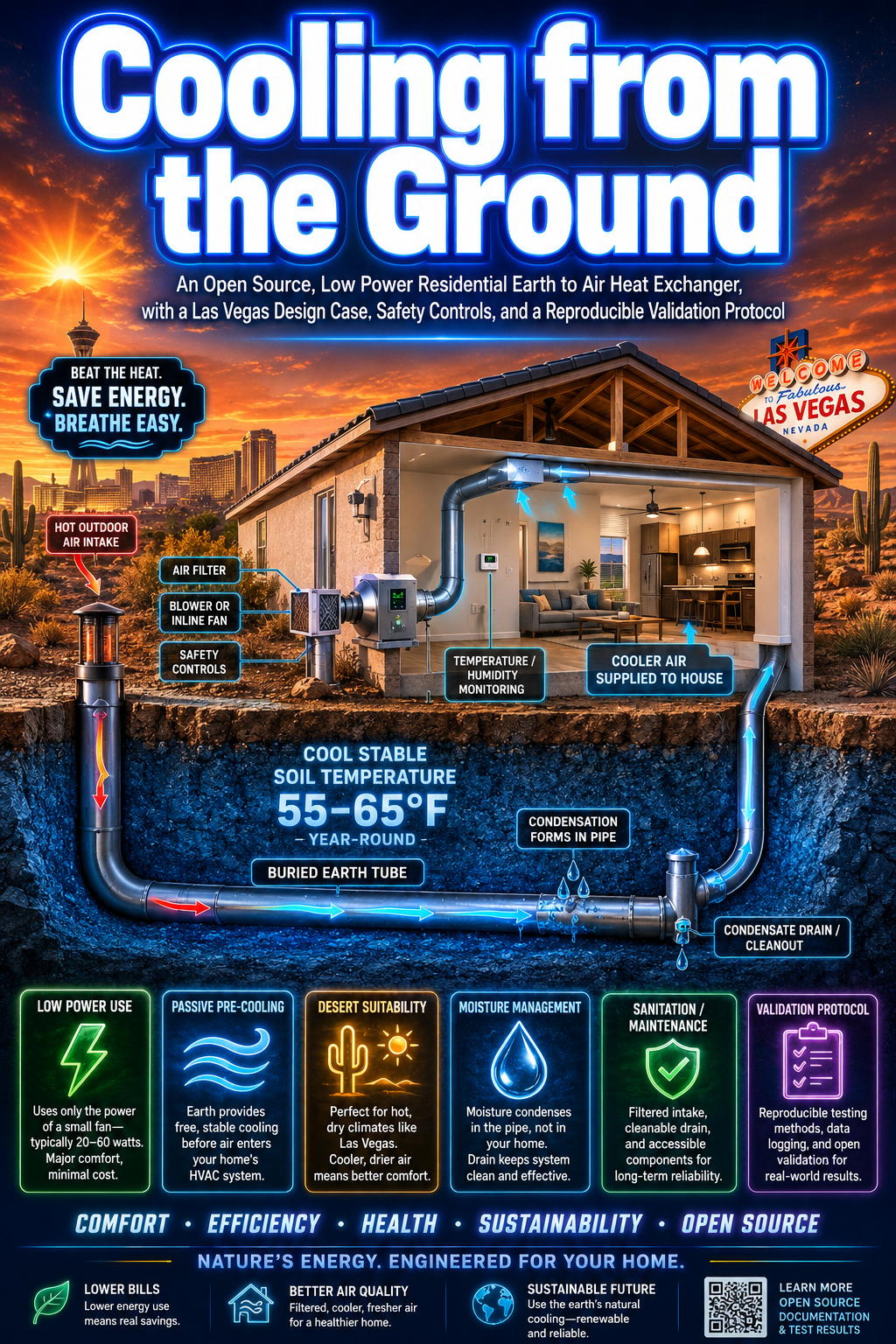
Earth to air heat exchangers, often called earth tubes, move outdoor or return air through buried ducts so that heat flows between the air and the surrounding soil. The concept can reduce cooling and heating energy because a fan requires far less power than a vapor compression system. What this project calls for is a forty foot, eight inch tube buried four feet deep, with a screened intake, an inline fan, a condensate slope, and a material cost below 300 United States dollars as of 2026 in Las Vegas, Nevada. What I am proposing is an appealing idea, but it cannot be applied universally, because soil at four feet is not always 55°F, the seasonal phase delay at that depth is not six months, fan electricity is not zero, drainage does not guarantee permanent freedom from mold, permits may be required, and a single short tube cannot be presumed to meet a whole house cooling load. This paper converts the useful core idea into a technically bounded, open source design. The proposed architecture uses site-measured ground temperature, one or more smooth and sealed parallel tubes, positive pressure operation, accessible condensate collection, filtration, a weather and smoke bypass, differential temperature control, radon testing, and documented commissioning. A first order effectiveness model is presented alongside a Las Vegas example. Using an illustrative overall heat transfer coefficient of 10 W per square meter kelvin, 105°F inlet air, and 77°F ground, one forty foot, eight inch tube is predicted to deliver approximately 2,208 to 3,298 Btu per hour across 100 to 300 cubic feet per minute, with outlet air from about 84°F to 94°F. Three parallel one hundred foot tubes at 100 cubic feet per minute each are predicted to approach 8,472 Btu per hour under the same ground condition. These values are design estimates, not measured prototype results. The proposed system is therefore best described as a low power air temperer, ventilation preconditioner, or hybrid cooling stage. Whole house standalone cooling is possible only when measured capacity equals the building load under site specific conditions. A complete installation, instrumentation, commissioning, maintenance, risk, and publication protocol is provided so that future claims can rest on reproducible evidence rather than slogans.
- Author Biography
- References
-
Air Conditioning Contractors of America. (2016). ANSI/ACCA 2 Manual J: Residential load calculation (8th ed.).
https://www.acca.org/standards/technical-manuals/manual-j
Al Ajmi, F., Loveday, D. L., & Hanby, V. I. (2006). The cooling potential of earth–air heat exchangers for domestic buildings in a desert climate. Building and Environment, 41(3), 235–244. https://doi.org/10.1016/j.buildenv.2005.01.027
American Society of Heating, Refrigerating and Air Conditioning Engineers. (2023). ANSI/ASHRAE Standard 55-2023: Thermal environmental conditions for human occupancy. https://www.ashrae.org/technical-resources/bookstore/standard-55-thermal-environmental-conditions-for-human-occupa ncy
American Society of Heating, Refrigerating and Air Conditioning Engineers. (2025). ANSI/ASHRAE Standard 62.2-2025: Ventilation and acceptable indoor air quality in residential buildings. https://www.ashrae.org/technical-resources/bookstore/standards-62-1-62-2
Chardome, G., & Feldheim, V. (2019). Heat transfer and condensation in an earth-air heat exchanger: 2D/3D numerical modeling validated by experimental measurements. Energy and Buildings, 205, 109532. https://doi.org/10.1016/j.enbuild.2019.109532
Clark County, Nevada. (n.d.). Do I need a permit? Building and Fire Prevention.
https://www.clarkcountynv.gov/government/departments/building___fire_prevention/how-do-i
Common Ground Alliance. (n.d.). 811 before you dig. Every dig. Every time. https://call811.com/
De Paepe, M., & Janssens, A. (2003). Thermo-hydraulic design of earth-air heat exchangers. Energy and Buildings, 35(4), 389–397. https://doi.org/10.1016/S0378-7788(02)00113-5
Duarte, R., Gomes, M. da G., Moret Rodrigues, A., & Pimentel, F. (2023). A large-diameter earth–air heat exchanger built for standalone office-room cooling: Monitoring results for hot and dry summer conditions. Applied Sciences, 13(22), 12134. https://doi.org/10.3390/app132212134
Duarte, R., Moret Rodrigues, A., Pimentel, F., & Gomes, M. da G. (2025). Design and performance of a large-diameter earth–air heat exchanger used for standalone office-room cooling. Applied Sciences, 15(14), 7938. https://doi.org/10.3390/app15147938
Goswami, D. Y., & Biseli, K. M. (1993). Use of underground air tunnels for heating and cooling agricultural and residential buildings. Florida Cooperative Extension Service, Institute of Food and Agricultural Sciences, University of Florida, Fact Sheet EES 78. https://ufdcimages.uflib.ufl.edu/IR/00/00/48/50/00001/EH21100.PDF
International Code Council. (2021). 2021 International Mechanical Code, Chapter 6: Duct systems.
https://codes.iccsafe.org/content/IMC2021P1/chapter-6-duct-systems
Kusuda, T., & Achenbach, P. R. (1965). Earth temperature and thermal diffusivity at selected stations in the United States. National Bureau of Standards Report 8972. https://doi.org/10.6028/NBS.RPT.8972
Lee, K. H., & Strand, R. K. (2008). The cooling and heating potential of an earth tube system in buildings. Energy and Buildings, 40(4), 486–494. https://doi.org/10.1016/j.enbuild.2007.04.003
Mihalakakou, G., Souliotis, M., Papadaki, M., Halkos, G., Paravantis, J., Makridis, S., & Papaefthimiou, S. (2022). Applications of earth-to-air heat exchangers: A holistic review. Renewable and Sustainable Energy Reviews, 155, 111921. https://doi.org/10.1016/j.rser.2021.111921
National Weather Service Las Vegas. (2021). Las Vegas, Nevada, 1991–2020 climate normals.
https://www.weather.gov/vef/1991-2020Normals
Occupational Safety and Health Administration. (n.d.a). 29 CFR 1926.651, Specific excavation requirements.
https://www.osha.gov/laws-regs/regulations/standardnumber/1926/1926.651
Occupational Safety and Health Administration. (n.d.b). 29 CFR 1926.652, Requirements for protective systems.
https://www.osha.gov/laws-regs/regulations/standardnumber/1926/1926.652
Peretti, C., Zarrella, A., De Carli, M., & Zecchin, R. (2013). The design and environmental evaluation of earth-to-air heat exchangers: A literature review. Renewable and Sustainable Energy Reviews, 28, 107–116. https://doi.org/10.1016/j.rser.2013.07.057
Pfafferott, J. (2003). Evaluation of earth-to-air heat exchangers with a standardised method to calculate energy efficiency. Energy and Buildings, 35(10), 971–983. https://doi.org/10.1016/S0378-7788(03)00055-0
U.S. Energy Information Administration. (2026, August 26). Electric Power Monthly, Table 5.6.A: Average price of electricity to ultimate customers by end use sector, by state, June 2026 and 2025. https://www.eia.gov/electricity/monthly/epm_table_grapher.php?t=epmt_5_6_a
U.S. Environmental Protection Agency. (2025, November 12). What is EPA's action level for radon and what does it mean?
https://www.epa.gov/radon/what-epas-action-level-radon-and-what-does-it-mean
U.S. Environmental Protection Agency. (2026, July 17). Reduce your smoke exposure.
https://www.epa.gov/wildfires/reduce-your-smoke-exposure
Vaz, J., Sattler, M. A., dos Santos, E. D., & Isoldi, L. A. (2011). Experimental and numerical analysis of an earth–air heat exchanger. Energy and Buildings, 43(9), 2476–2482. https://doi.org/10.1016/j.enbuild.2011.06.003
- Cover Image
-
- Downloads
- Published
- 2026-09-08
- Section
- Articles
- Categories
- License
-
Copyright (c) 2026 Author(s) retain copyright and articles are published under CC BY 4.0.

This work is licensed under a Creative Commons Attribution 4.0 International License.
