
Autism Etiology and Individualized Care
- Authors
-
-
Lucy Black
Author
-
- Abstract
-
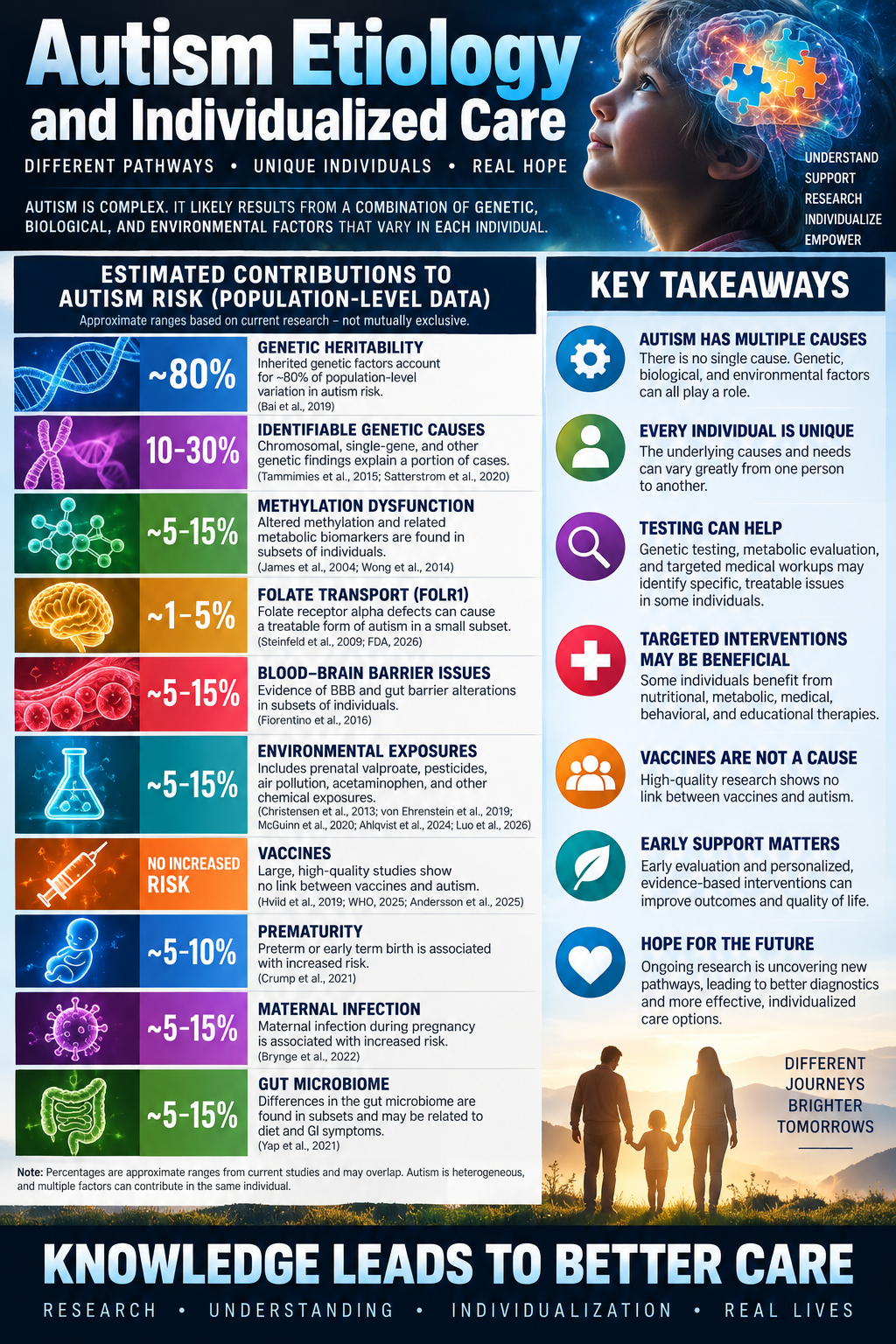
Families encounter competing explanations of autism and treatments promoted as correcting an underlying cause. A percentage breakdown could appear useful, but genetic liability, metabolic findings, environmental exposures, and treatment response describe different quantities and can overlap within the same child. My objective in this study is to examine which quantitative statements about autism etiology are defensible and how this evidence should inform expectations for individualized care. I use a targeted narrative review examining human genetic, epidemiological, mechanistic, and intervention research, together with clinical guidance and regulatory updates available in May 2026. Including reported estimates were retained with their original denominators and study contexts; incompatible measures were not pooled. My findings were that a large multinational study estimated autism heritability at 80.8%. Clinical genetic testing identifies explanatory findings in a smaller, selected proportion. No validated population fraction can be assigned to impaired methylation, blood–brain barrier dysfunction, or generalized chemical exposure. Small methylcobalamin and folinic-acid trials do not establish causal subtypes. However FOLR1-related cerebral folate transport deficiency provides a specific example of a treatable genetic disorder. Large studies and current international review evidence do not seem to support vaccines as a cause of autism. A direct study on the topic needs to be done for more details. Etiologic information can sometimes change care, but treatment should be selected by clinical findings, credible evidence, and meaningful goals. Nonresponse to a supplement does not diagnose another cause or establish that further experimental therapies will help.
- Author Biography
- References
-
Absolutely. Here they are with a clear blank space between every reference:
1. National Institute of Mental Health. Autism spectrum disorder. Revised 2025. [Source](https://www.nimh.nih.gov/health/publications/autism-spectrum-disorder?utm_source=chatgpt.com)
2. Bai D, Yip BHK, Windham GC, et al. Association of genetic and environmental factors with autism in a 5-country cohort. *JAMA Psychiatry.* 2019;76(10):1035–1043. [Source](https://doi.org/10.1001/jamapsychiatry.2019.1411?utm_source=chatgpt.com)
3. Tammimies K, Marshall CR, Walker S, et al. Molecular diagnostic yield of chromosomal microarray analysis and whole-exome sequencing in children with autism spectrum disorder. *JAMA.* 2015;314(9):895–903. [Source](https://doi.org/10.1001/jama.2015.10078?utm_source=chatgpt.com)
4. James SJ, Cutler P, Melnyk S, et al. Metabolic biomarkers of increased oxidative stress and impaired methylation capacity in children with autism. *American Journal of Clinical Nutrition.* 2004;80(6):1611–1617. [Source](https://doi.org/10.1093/ajcn/80.6.1611?utm_source=chatgpt.com)
5. Wong CCY, Meaburn EL, Ronald A, et al. Methylomic analysis of monozygotic twins discordant for autism spectrum disorder and related behavioural traits. *Molecular Psychiatry.* 2014;19(4):495–503. [Source](https://doi.org/10.1038/mp.2013.41?utm_source=chatgpt.com)
6. Steinfeld R, Grapp M, Kraetzner R, et al. Folate receptor alpha defect causes cerebral folate transport deficiency: a treatable neurodegenerative disorder associated with disturbed myelin metabolism. *American Journal of Human Genetics.* 2009;85(3):354–363. [Source](https://doi.org/10.1016/j.ajhg.2009.08.005?utm_source=chatgpt.com)
7. US Food and Drug Administration. FDA approves first treatment for patients with cerebral folate transport deficiency. 2026. [Source](https://www.fda.gov/news-events/press-announcements/fda-approves-first-treatment-patients-cerebral-folate-transport-deficiency?utm_source=chatgpt.com)
8. Fiorentino M, Sapone A, Senger S, et al. Blood–brain barrier and intestinal epithelial barrier alterations in autism spectrum disorders. *Molecular Autism.* 2016;7:49. [Source](https://doi.org/10.1186/s13229-016-0110-z?utm_source=chatgpt.com)
9. Christensen J, Grønborg TK, Sørensen MJ, et al. Prenatal valproate exposure and risk of autism spectrum disorders and childhood autism. *JAMA.* 2013;309(16):1696–1703. [Source](https://doi.org/10.1001/jama.2013.2270?utm_source=chatgpt.com)
10. von Ehrenstein OS, Ling C, Cui X, et al. Prenatal and infant exposure to ambient pesticides and autism spectrum disorder in children: population based case-control study. *BMJ.* 2019;364:l962. Correction: *BMJ.* 2019;365:l4032. [Source](https://doi.org/10.1136/bmj.l962?utm_source=chatgpt.com)
11. McGuinn LA, Windham GC, Kalkbrenner AE, et al. Early life exposure to air pollution and autism spectrum disorder: Findings from a multisite case-control study. *Epidemiology.* 2020;31(1):103–114. [Source](https://doi.org/10.1097/EDE.0000000000001109?utm_source=chatgpt.com)
12. Ahlqvist VH, Sjöqvist H, Dalman C, et al. Acetaminophen use during pregnancy and children’s risk of autism, ADHD, and intellectual disability. *JAMA.* 2024;331(14):1205–1214. [Source](https://doi.org/10.1001/jama.2024.3172?utm_source=chatgpt.com)
13. Luo S, Gong Q, Ai Y, et al. Prenatal acetaminophen (paracetamol) use and the risk of autism and/or attention-deficit/hyperactivity disorder among sibling-matched cohorts. *JAMA Internal Medicine.* 2026. Published online. [Source](https://doi.org/10.1001/jamainternmed.2026.2215?utm_source=chatgpt.com)
14. Hviid A, Hansen JV, Frisch M, Melbye M. Measles, mumps, rubella vaccination and autism: A nationwide cohort study. *Annals of Internal Medicine.* 2019;170(8):513–520. [Source](https://doi.org/10.7326/M18-2101?utm_source=chatgpt.com)
15. World Health Organization. WHO expert group’s new analysis reaffirms there is no link between vaccines and autism. 2025. [Source](https://www.who.int/news/item/11-12-2025-who-expert-group-s-new-analysis-reaffirms-there-is-no-link-between-vaccines-and-autism?utm_source=chatgpt.com)
16. Crump C, Sundquist J, Sundquist K. Preterm or early term birth and risk of autism. *Pediatrics.* 2021;148(3):e2020032300. [Source](https://doi.org/10.1542/peds.2020-032300?utm_source=chatgpt.com)
17. Brynge M, Sjöqvist H, Gardner RM, Lee BK, Dalman C, Karlsson H. Maternal infection during pregnancy and likelihood of autism and intellectual disability in children in Sweden: a negative control and sibling comparison cohort study. *Lancet Psychiatry.* 2022;9(10):782–791. [Source](https://pubmed.ncbi.nlm.nih.gov/36087610/?utm_source=chatgpt.com)
18. Yap CX, Henders AK, Alvares GA, et al. Autism-related dietary preferences mediate autism-gut microbiome associations. *Cell.* 2021;184(24):5916–5931.e17. Erratum: *Cell.* 2024;187(2):495–510. [Source](https://doi.org/10.1016/j.cell.2021.10.015?utm_source=chatgpt.com)
19. Satterstrom FK, Kosmicki JA, Wang J, et al. Large-scale exome sequencing study implicates both developmental and functional changes in the neurobiology of autism. *Cell.* 2020;180(3):568–584.e23. [Source](https://doi.org/10.1016/j.cell.2019.12.036?utm_source=chatgpt.com)
20. Hyman SL, Levy SE, Myers SM; Council on Children with Disabilities; Section on Developmental and Behavioral Pediatrics. Identification, evaluation, and management of children with autism spectrum disorder. *Pediatrics.* 2020;145(1):e20193447. [Source](https://doi.org/10.1542/peds.2019-3447?utm_source=chatgpt.com)
21. Manickam K, McClain MR, Demmer LA, et al. Exome and genome sequencing for pediatric patients with congenital anomalies or intellectual disability: an evidence-based clinical guideline of the American College of Medical Genetics and Genomics. *Genetics in Medicine.* 2021;23(11):2029–2037. [Source](https://doi.org/10.1038/s41436-021-01242-6?utm_source=chatgpt.com)
22. Hendren RL, James SJ, Widjaja F, Lawton B, Rosenblatt A, Bent S. Randomized, placebo-controlled trial of methyl B12 for children with autism. *Journal of Child and Adolescent Psychopharmacology.* 2016;26(9):774–783. [Source](https://doi.org/10.1089/cap.2015.0159?utm_source=chatgpt.com)
23. American Academy of Pediatrics. Frequently asked questions for pediatricians and other prescribing pediatric clinicians: Leucovorin use in autism and cerebral folate deficiency. 2026.
24. Frye RE, Slattery J, Delhey L, et al. Folinic acid improves verbal communication in children with autism and language impairment: a randomized double-blind placebo-controlled trial. *Molecular Psychiatry.* 2018;23(2):247–256. [Source](https://doi.org/10.1038/mp.2016.168?utm_source=chatgpt.com)
25. Panda PK, Sharawat IK, Saha S, Gupta D, Palayullakandi A, Meena K. Retraction note: Efficacy of oral folinic acid supplementation in children with autism spectrum disorder: a randomized double-blind, placebo-controlled trial. *European Journal of Pediatrics.* 2026;185:109. [Source](https://doi.org/10.1007/s00431-026-06769-x?utm_source=chatgpt.com)
26. American Academy of Pediatrics. Interim guidance from the American Academy of Pediatrics: Use of leucovorin in autistic pediatric patients. 2025.
27. Andersson NW, Bech Svalgaard I, Hoffmann SS, Hviid A. Aluminum-adsorbed vaccines and chronic diseases in childhood: A nationwide cohort study. *Annals of Internal Medicine.* 2025;178(10):1369–1377. Correction: 178(10):1527. [Source](https://doi.org/10.7326/ANNALS-25-00997?utm_source=chatgpt.com)
28. Centers for Disease Control and Prevention. Treatment and intervention for autism spectrum disorder. 2024.
29. National Institute for Health and Care Excellence. Autism spectrum disorder in under 19s: support and management. Clinical guideline CG170. 2013; updated 2021.
- Cover Image
-
- Downloads
- Published
- 2026-09-09
- Section
- Articles
- Categories
- License
-
Copyright (c) 2026 Lucy Black (Author)

This work is licensed under a Creative Commons Attribution 4.0 International License.
