
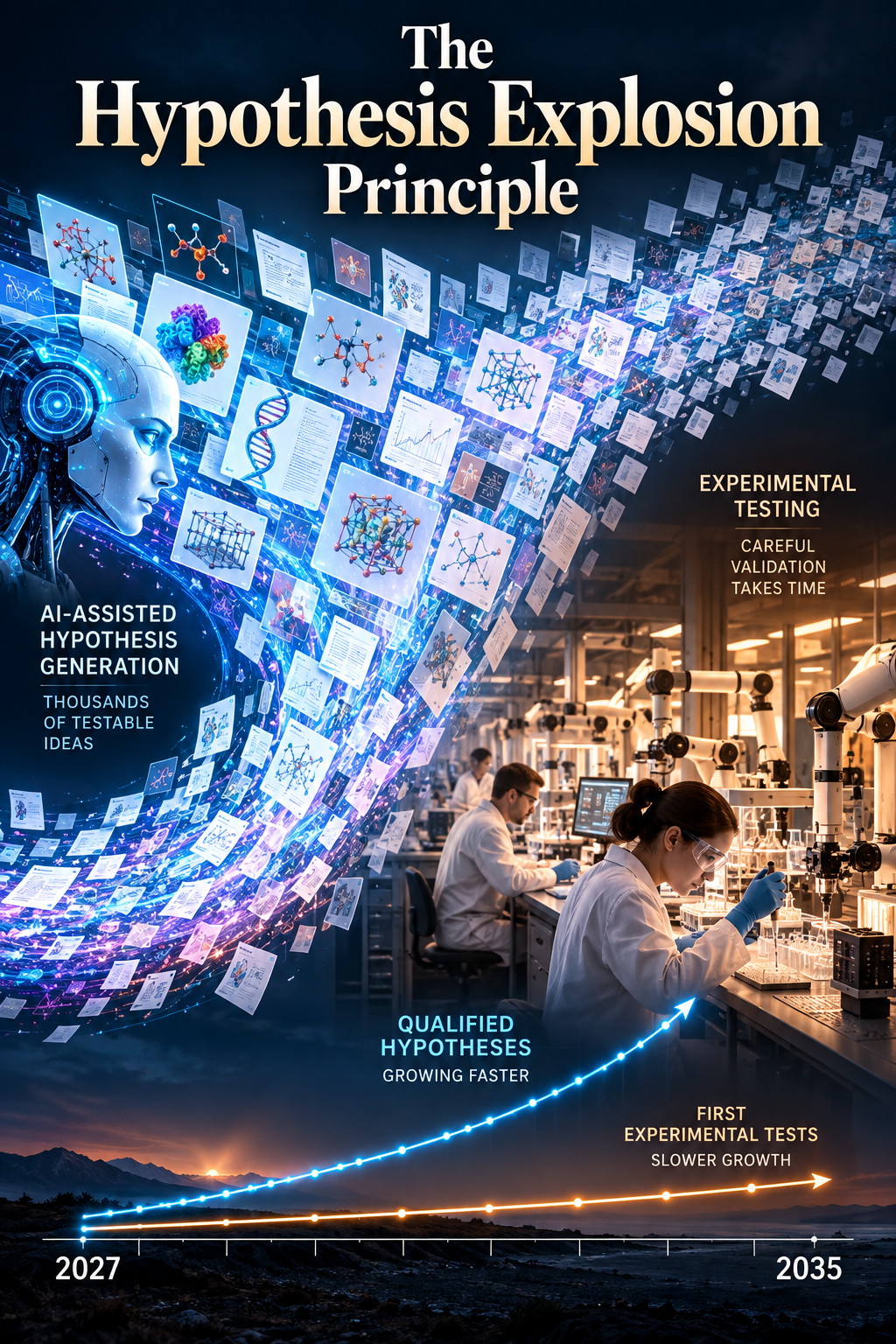
The Hypothesis Explosion Principle
- Authors
-
-
M. Sturbl
Author
-
- Abstract
-
Artificial intelligence can produce research proposals faster than laboratories can examine them. Whether that difference will widen over the next decade remains an empirical question. This paper proposes the Hypothesis Explosion Principle: between 2027 and 2035, the production of distinct, experimentally testable AI-assisted hypotheses will grow faster than the completion of their first direct experimental tests in selected physical and biological sciences. A registry-based framework separates raw suggestions, qualified hypotheses, completed tests, and independently replicated support. Its primary forecast is a doubling of the hypothesis-to-test flow ratio between 2027–2028 and 2034–2035 in a fixed laboratory panel, with growth in the hypothesis count itself. Nine secondary forecasts examine testing coverage, unresolved claims, experimental costs, screening, and laboratory automation. The framework gives explicit outcomes that would contradict each forecast and distinguishes a rising stock of untested ideas from a harmful research backlog. Existing studies establish the plausibility of large-scale generation and automated experimentation; they do not establish the proposed future divergence. The paper supplies definitions, a stock-and-flow model, and an evaluation protocol rather than new empirical results. Its central claim fails if experimental testing keeps pace with qualified hypothesis production. A decline in testing coverage alone would not show that science has become less productive.
- Author Biography
- References
-
[1] King, R. D., et al. (2009). The automation of science. Science, 324, 85–89. Source
[2] Si, C., Yang, D., & Hashimoto, T. (2024). Can LLMs Generate Novel Research Ideas? A Large-Scale Human Study with 100+ NLP Researchers. arXiv:2409.04109. Cited version: preprint. Source
[3] Gottweis, J., et al. (2026). Accelerating scientific discovery with Co-Scientist. Nature. Source
[4] Jacobsson, J. (2026). AI-Generated Hypotheses and the Emergence of Autonomous Scientific Discovery. ACS Materials Letters, 8, 1457–1464. Source
[5] Merchant, A., et al. (2023). Scaling deep learning for materials discovery. Nature, 624, 80–85. Source
[6] Burger, B., et al. (2020). A mobile robotic chemist. Nature, 583, 237–241. Source
[7] Szymanski, N. J., et al. (2023). An autonomous laboratory for the accelerated synthesis of inorganic materials. Nature, 624, 86–91. Corrected article text consulted in 2026. Source
[8] Ho, S.-T., Liu, M., Nghiem, H., & Huang, F. (2026). SoundnessBench: Can Your AI Scientist Really Tell Good Research Ideas from Bad Ones? arXiv:2605.30329. Preprint. Source
[9] Little, J. D. C. (1961). A proof for the queuing formula: L = λW. Operations Research, 9, 383–387. Source
[10] Nosek, B. A., Ebersole, C. R., DeHaven, A. C., & Mellor, D. T. (2018). The preregistration revolution. Proceedings of the National Academy of Sciences, 115, 2600–2606. Source
- Cover Image
-
- Downloads
- Published
- 2026-09-30
- Section
- Articles
- Categories
- License
-
Copyright (c) 2026 Author(s) retain copyright and articles are published under CC BY 4.0.

This work is licensed under a Creative Commons Attribution 4.0 International License.
