
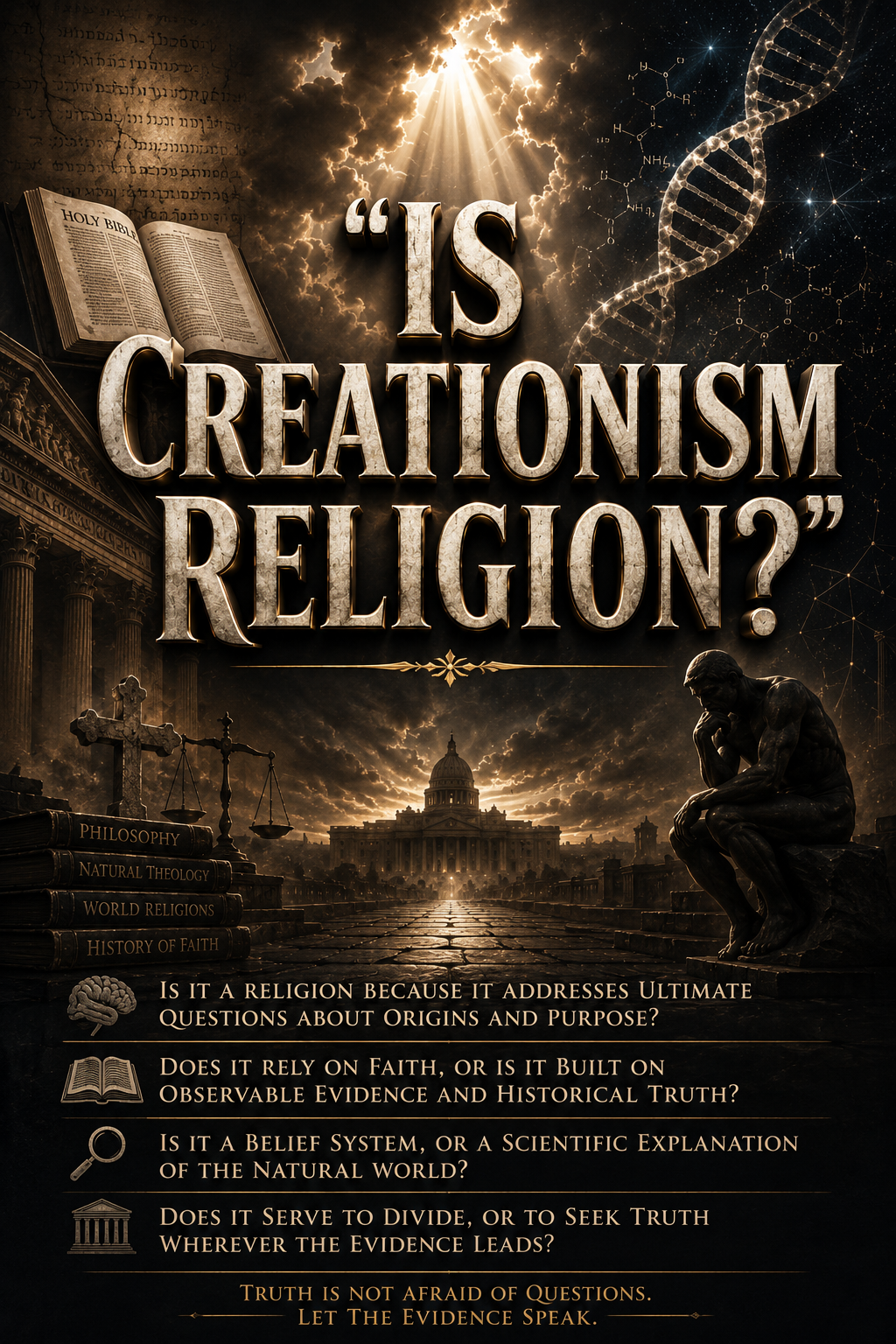
Is Creationism Religion?
- Authors
-
-
Bergman J.
Author
-
- Abstract
-
The recurring charge that creationism is “religion” while evolution is “science” assumes that the two can be cleanly separated by the definition of religion itself. This paper argues that the assumption fails on its own terms. Drawing on admissions from within the evolutionary establishment, including the philosopher of biology Michael Ruse, the biologist and first Director General of UNESCO Julian Huxley, the moral philosopher Mary Midgley, the geneticist Richard Lewontin, and the sociobiologist E. O. Wilson, it shows that leading evolutionists have themselves described evolution as functioning as a secular religion, a myth, or an a priori metaphysical commitment. It then situates that concession against the legal record, in which the United States Supreme Court has recognized Secular Humanism among non-theistic religions (Torcaso v. Watkins, 1961) yet has struck down every attempt to teach the theistic account of origins in public science classrooms while protecting the naturalistic account (Epperson, 1968; McLean, 1982; Edwards, 1987; Kitzmiller, 2005). The result is an asymmetry: one worldview is mandated and the other is prohibited. Following the ornithologist and evolutionist turned creationist Douglas Dewar, the paper concludes that what is presented to the public as settled science actually carries the freight of what Dewar called the Transformist Illusion. A closing section anticipates the strongest objections to this thesis and answers them.
- Author Biography
- References
-
[1] Ruse, M. (2000, May 13). How evolution became a religion: Creationists correct? Darwinians wrongly mix science with morality, politics. National Post, pp. B1, B3, B7.
[2] Ruse, M. (2003). Is evolution a secular religion? Science, 299(5612), 1523–1524. https://doi.org/10.1126/science.1082968
[3] Ruse, M. (2017). Darwinism as religion: What literature tells us about evolution. Oxford University Press.
[4] Huxley, J. (1957). Religion without revelation (rev. ed.). Harper & Brothers. (Original work published 1927.)
[5] Huxley, J. (1964). Essays of a humanist. Harper & Row.
[6] Midgley, M. (1985). Evolution as a religion: Strange hopes and stranger fears. Methuen.
[7] Midgley, M. (1987). Evolution as a religion: A comparison of prophecies. Zygon, 22(2), 179–194. https://doi.org/10.1111/j.1467-9744.1987.tb00845.x
[8] Lewontin, R. C. (1997, January 9). Billions and billions of demons [Review of the book The Demon-Haunted World, by C. Sagan]. The New York Review of Books, 44(1), 31.
[9] Torcaso v. Watkins, 367 U.S. 488, 495 n.11 (1961).
[10] Epperson v. Arkansas, 393 U.S. 97 (1968).
[11] McLean v. Arkansas Board of Education, 529 F. Supp. 1255 (E.D. Ark. 1982); Edwards v. Aguillard, 482 U.S. 578 (1987).
[12] Kitzmiller v. Dover Area School District, 400 F. Supp. 2d 707 (M.D. Pa. 2005). [13] Dewar, D. (1957). The transformist illusion. Dehoff Publications.
- Cover Image
-
- Downloads
- Published
- 2026-07-16
- Section
- Articles
- Categories
Most read articles by the same author(s)
- Bergman J., Are Lizards Observed Evolving Live Birth Evidence for Macroevolution? , Truth in Research: Vol. 1 No. 1 (2026): Truth in Research: Foundations of Scientific Inquiry
- Bergman J., D. Budinsky, M. Nailor, Does Simple Clumping Explain the Origin of Multicellularity? , Truth in Research: Vol. 1 No. 1 (2026): Truth in Research: Foundations of Scientific Inquiry
- Bergman J., Why Evolution Has Failed the Sciences , Truth in Research: Vol. 1 No. 1 (2026): Truth in Research: Foundations of Scientific Inquiry
- Bergman J., Regulatory Module Complexity and the Origin of Feathers , Truth in Research: Vol. 1 No. 1 (2026): Truth in Research: Foundations of Scientific Inquiry