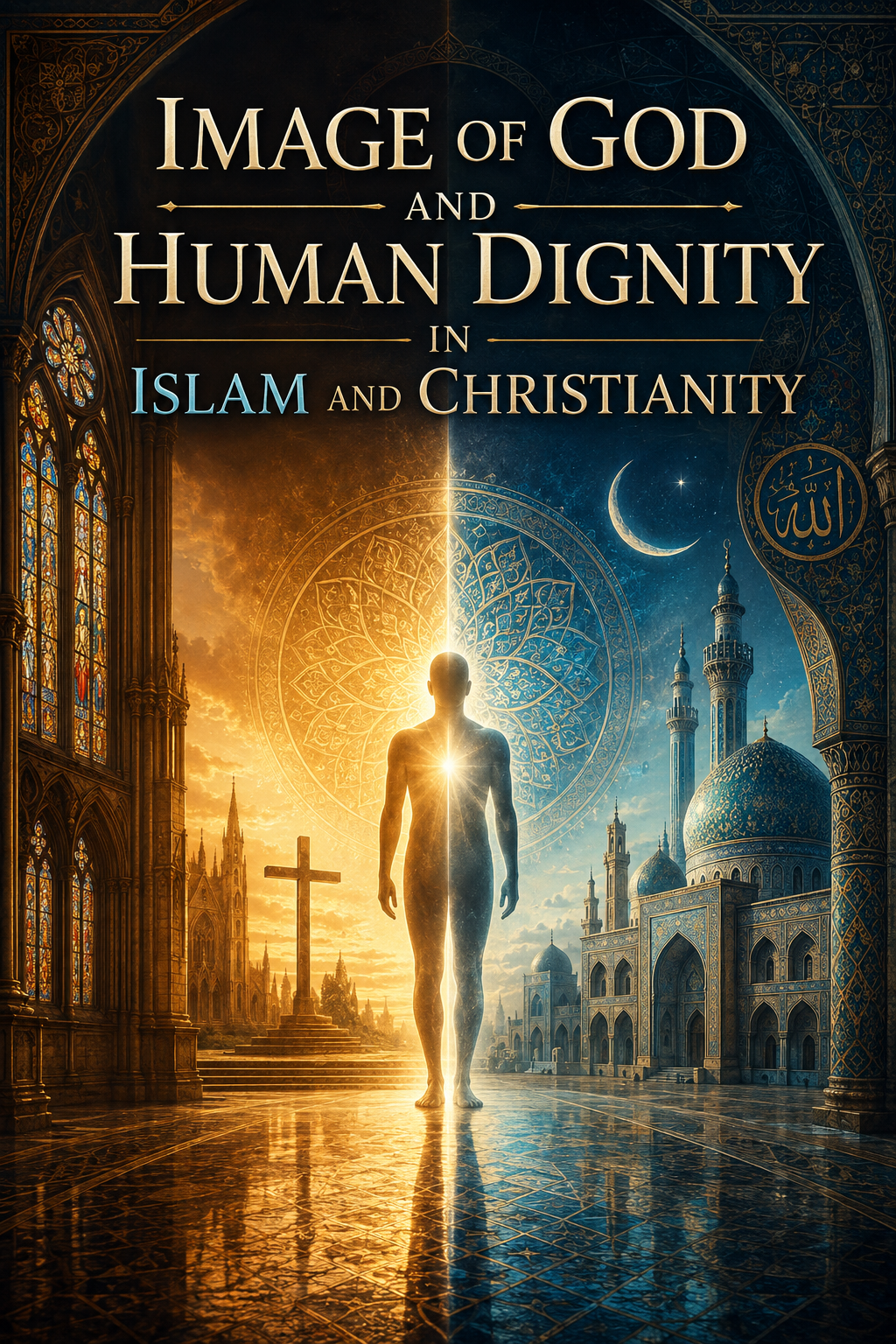
Image of God and Human Dignity in Islam and Christianity: From Discourses of Likeness to the Logic of Divine Unity

Authors
  • Thomas Samuel Petersson

    Quest Academy

    Author

  • George Nasser

    Author

Abstract

This article offers a comparative theological analysis of how Islam and Christianity speak about humanity “in the image” of God, and what this implies for divine unity and human dignity. On the Islamic side, it examines the hadith “God created Adam in His image” within the framework of tawḥīd, showing that a strictly unitary concept of God makes it difficult to give a robust account of mankind as a reflection of God without either reducing “image” language to thin metaphor or drifting toward problematic corporealism (mujassimah). On the Christian side, it argues that Trinitarian theology, which confesses God as one in essence and three in persons, can coherently affirm humanity as a genuine reflection of God’s unity-in-Triunity while firmly rejecting any notion that God possesses a physical body. The study traces how Islamic and Christian discourses handle the tension between likeness and transcendence, and contends that Christian Triunity provides a more logically adequate framework for understanding the human person as a reflection of divine unity. Finally, it explores the implications of these differing accounts for human dignity, the critique of corporealist theology, and the theological grounding of the unity of humankind.

Author Biographies
  1. Thomas Samuel Petersson, Quest Academy


    Tomas Samuel Petersson is a Swedish theologian and apologist of Egyptian background, specializing in Christian–Muslim relations, Islamic studies, and comparative philosophy and theology. He is currently a PhD candidate researching discipleship for new Salafi radical Muslims, focusing on theological, pastoral, and methodological frameworks for forming former radicals into mature Christian disciples.


    Academic profile


    Petersson holds a Master of Ministry with a concentration in Islamic Studies, completing a thesis on contemporary Muslim debates about the Trinity with particular focus on Rahmatullah Kairanawi and Christian responses to his critique. He also earned a Mini MBA from IBSS Denmark (Cairo campus), a Bachelor of Law from Ain Shams University with four years of intensive study in Sharia law, and a diploma in psychological counseling from Phoenix Academy in Canada.

    In addition to his formal degrees, he has completed several specialist programs in apologetics and leadership, including core and advanced modules with RZIM in apologetics, Christology, and worldviews, and certifications as an Al Massira trainer and Haggai Institute facilitator and evangelist.


    Academic and ministry appointments


    Petersson serves as Teacher in Christian Apologetics (Islam) and faculty member at Quest Academy in the United Kingdom, a position he has held since 2024. Previously, he directed the Arabic Program at Mission Muslim World University in the United States between 2023 and 2024, overseeing Arabic-language theological training focused on mission and Muslim engagement.

    Alongside his academic roles, he has maintained a long-standing pastoral ministry, serving as Chaplain with the Salvation Army in Stockholm from 2016 to 2025 and as church assistant at Rinkeby International Church in 2016.


    Teaching and research interests


    His teaching and research interests lie in comparative philosophy and theology, particularly the doctrinal intersections and tensions between Islamic and Christian thought. He works extensively in apologetics and the philosophical defense of the Christian faith, with additional interests in political philosophy in religious contexts and in interfaith dialogue and formal religious debates.

    These interests shape his classroom teaching, public lectures, and written work, giving his scholarship a distinct focus on theological argumentation, doctrinal clarity, and cross-confessional engagement.


    Publications and writing


    Petersson is actively engaged in academic publishing, with several peer‑reviewed articles under review or in progress. These include studies on divine unity and relationality in Islamic conceptions of tawḥīd, Christology in the Qur’an, the theology of Gethsemane in Matthew 26 in conversation with Muslim objections, and a Thomistic–Aristotelian model of the Latin Trinity as a resource for evangelical apologetics.

    He is also developing research on the Qur’anic account of Jesus’ crucifixion, death, and vindication, engaging both classical Muslim exegesis and historical-critical approaches. Beyond journals, he contributes to political and religious newspapers in Sweden—such as Världen Idag, Dagen, and Hemmets Vän—bringing academic theological reflection into public discourse.


    Books


    Petersson is the author of “It Is Your Time to Follow Me,” an apologetic biography that combines narrative with theological reflection. His book “The Trinity Revealed: A Defense on the Trinity” offers a sustained apologetic engagement with Islamic critiques of Trinitarian doctrine.

    He is currently preparing “In Jesus eyes: The Story of the kingdom that we all know,” which focuses on youth and young generation understanding and relation with God from a very new style and perspective.


    Public speaking and media work


    As a frequent lecturer on apologetics and theology, Petersson has spoken across Europe on issues of Christian–Muslim relations, monotheism, and the Trinity. Notably, he delivered a lecture titled “Democracy Between Islam and Europe” at the European Parliament and has participated in conferences such as “Set My People Free,” addressing apostasy in Islam.

    He has appeared on numerous television programs comparing the reliability of Christian faith and Islam, and hosted the satellite TV program “Life Choices,” which focused on developing Muslim youth and on human and organizational development. He has also been featured as a guest on national TV programs discussing HR and business psychological counseling.


    Professional experience in apologetics and pastoral care


    Since 2013, Petersson has served as a preacher and lecturer in churches and academic settings, combining pastoral ministry with theological education. He has extensive experience mentoring converts to Christianity from Muslim backgrounds across countries including Egypt, Tunisia, Lebanon, Turkey, Bahrain, Qatar, the USA, and Sweden, emphasizing doctrinal grounding and holistic discipleship.

    He regularly leads workshops and conferences on interfaith dialogue and theology, equipping churches and institutions to engage thoughtfully and biblically with Islam and other world religions.


    Leadership, training, and counseling


    Beyond theology, Petersson has broad experience in leadership development and soft‑skills training, having trained over 350,000 individuals worldwide in leadership, communication, and public speaking. He has conducted business psychological counseling workshops for multinational corporations and institutions, integrating psychological insight with ethical and organizational development.

    He has also overseen recruitment and training initiatives for leading international organizations, demonstrating competence in organizational development, human resources, and strategic training design.


    Languages and background


    Petersson is a Swedish national of Egyptian background, residing in Sweden. He is a native speaker of Arabic, fluent in English, with very good Swedish and good proficiency in Hebrew, enabling him to work across linguistic, cultural, and ecclesial contexts.

    His bilingual and cross‑cultural profile informs his academic and ministry work, particularly in Christian–Muslim dialogue and in theological education for Arabic‑speaking communities.


  2. George Nasser


    Founder & Operational Manager of Christian Center for translation and research.

References

Monographs and edited volumes

1. Abdel Haleem, M. A. S., trans. The Qur’an. Oxford: Oxford University Press, 2004.

2. Ayres, Lewis. Nicaea and Its Legacy: An Approach to Fourth-Century Trinitarian Theology. Oxford: Oxford University Press, 2004.

3. Ayres, Lewis. Augustine and the Trinity. Cambridge: Cambridge University Press, 2010.

4. Cortez, Marc. Theological Anthropology: A Guide for the Perplexed. London: T&T Clark, 2010.

5. Emery, Gilles. The Trinitarian Theology of St Thomas Aquinas. Translated by Francesca Aran Murphy. Oxford: Oxford University Press, 2007.

6. Frank, Richard M. Beings and Their Attributes: The Teaching of the Basrian School of the Mu‘tazila in the Classical Period. Albany: State University of New York Press, 1978.

7. Holmes, Stephen R. The Quest for the Trinity: The Doctrine of God in Scripture, History and Modernity. Downers Grove, IL: InterVarsity Press, 2012.

8. Hoover, Jon. Ibn Taymiyya’s Theodicy of Perpetual Optimism. Islamic Philosophy, Theology and Science 73. Leiden: Brill, 2007.

9. Kilner, John F. Dignity and Destiny: Humanity in the Image of God. Grand Rapids, MI: Eerdmans, 2015.

10. National Council of Churches. The Holy Bible: New Revised Standard Version. Nashville: Thomas Nelson, 1989.

11. Rudolph, Ulrich. Al-Māturīdī and the Development of Sunnī Theology in Samarqand. Translated by Rodrigo Adem. Leiden: Brill, 2015.

12. Sachedina, Abdulaziz. Islam and the Challenge of Human Rights. Oxford: Oxford University Press, 2009.

13. Winter, Tim, ed. The Cambridge Companion to Classical Islamic Theology. Cambridge: Cambridge University Press, 2008.

Classical and scriptural works (editions)

14. Aquinas, Thomas. Summa Theologiae. Blackfriars edition. New York: McGraw Hill, 1964–81.

15. Augustine. De Trinitate. Corpus Christianorum, Series Latina 50, 50A. Turnhout: Brepols, 1968.

16. Basil of Caesarea. De Spiritu Sancto. In Sources Chrétiennes 17bis. Paris: Cerf.

17. Gregory of Nazianzus. Orationes theologicae 31 (The Fifth Theological Oration). In Sources Chrétiennes 250. Paris: Cerf.

18. Novum Testamentum Graece. 28th ed. Nestle Aland. Stuttgart: Deutsche Bibelgesellschaft.

Articles and reference entries

19. Holtzman, Livnat. “Anthropomorphism.” In Encyclopaedia of Islam, THREE, edited by Kate Fleet et al. Leiden: Brill (online edition).

20. Kilby, Karen. “Perichoresis and Projection: Problems with Social Doctrines of the Trinity.” New Blackfriars 81, no. 957 (2000): 432–445.

21. Williams, Wesley. “Aspects of the Creed of Imam Aḥmad Ibn Ḩanbal: A Study of Anthropomorphism in Early Islamic Discourse.” International Journal of Middle East Studies 34, no. 3 (2002).

Primary Islamic texts

22. Al Nawawī, Yahyā ibn Sharaf. Al Minhāj bi Sharḥ Ṣaḥīḥ Muslim ibn al Ḥajjāj. commentary on Kitāb al-Birr. Beirut: Dār al Maʿrifa, n.d.

23. Ṣaḥīḥ al Bukhārī. Kitāb al Istiʾdhān, no. 6227. In The Translation of the Meanings of Ṣaḥīḥ al Bukhārī. Translated by Muhammad Muhsin Khan. Riyadh: Darussalam, 1997.

24. Muslim, Imām. Sahih Muslim. Translated by Abdul Hamid Siddiqi. Lahore: Sh. Muhammad Ashraf, n.d.

Cover Image
Published
2026-08-04
Section
Articles
Categories
License

Copyright (c) 2026 Author(s) retain copyright and articles

Creative Commons License

This work is licensed under a Creative Commons Attribution 4.0 International License.

Most read articles by the same author(s)