
The Evolution of Skin Color vs Noah's Flood
- Authors
-
-
R. Hopkins
Author
-
- Abstract
-
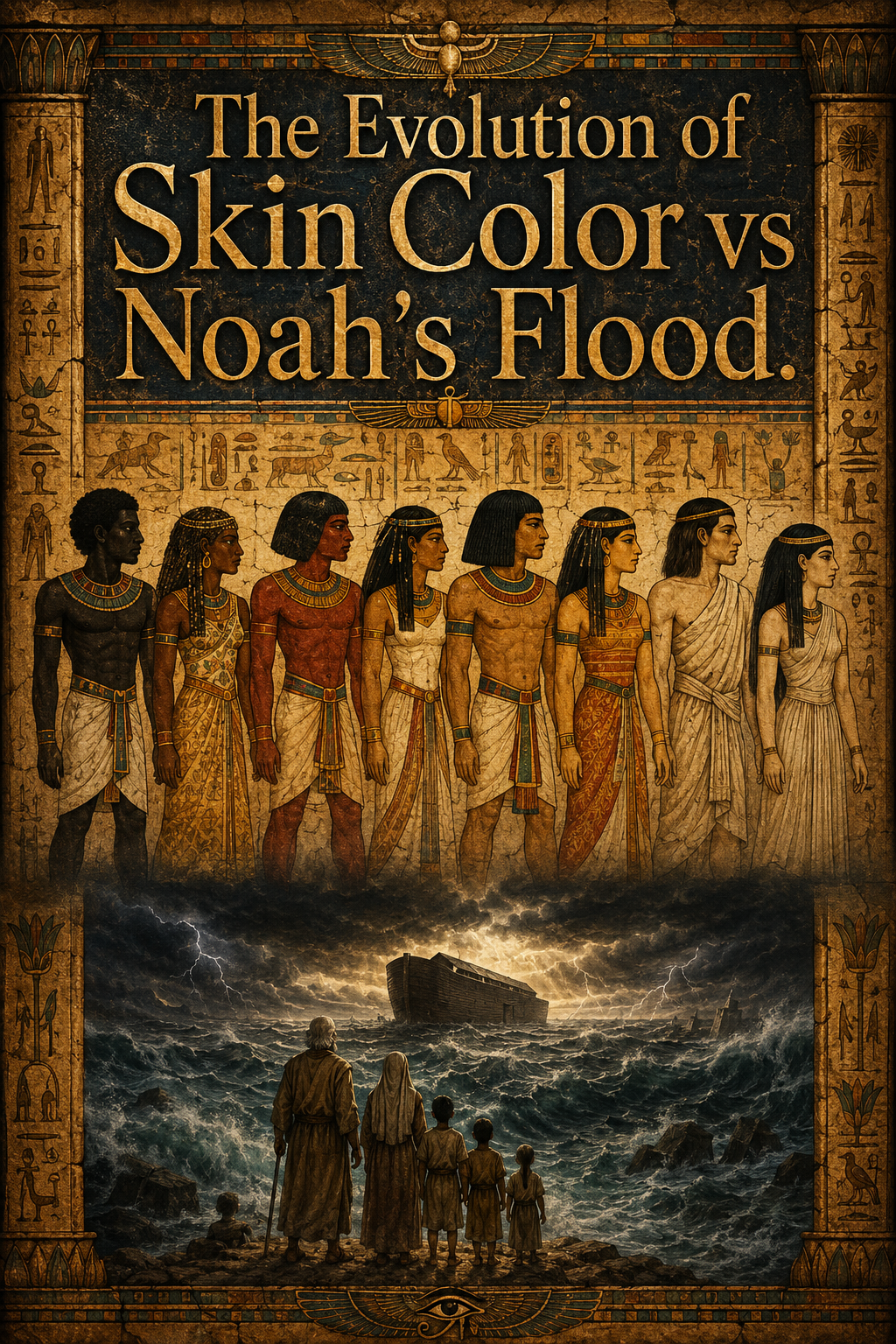
I have cut and carved stone for over fifty years, and that trade has taken me many times into the quarries and tombs of Egypt. On those tomb walls the ancient artists did something I never thought to much about till the idea of young earth creation was introduced to me: they painted human beings in clearly different colors, deep red-brown for the Egyptians themselves, brown and black for the Nubians of the south, and paler, tawny tones for the Libyans and Asiatics of the north and east. They saw a world full of different colored peoples and they marked it, carefully, in mineral paint, from the very first painted tomb at Hierakonpolis around 3200 BCE, a thousand years before the Great Pyramid, straight through the Book of Gates processions of the New Kingdom. In this paper I set that eyewitness record beside two other things. The first is what modern science says about why human skin varies: the work of Jablonski and Chaplin and others showing that skin color is the slow adjustment of melanin to ultraviolet sunlight, built up over tens of thousands of years as people migrated into different light, with specific light-skin genes spreading only within the last several thousand years. The second is the chronology of the Flood account, in which one closely related family leaves the Ark only a few centuries before these tombs were painted and yet must give rise to every diverse people on earth. Laying the art beside the biology beside the calendar, I argue that the timing does not hold, and that the painted walls of Egypt record a world far older than a single-family origin allows. I take the main objection, that a few genes can shift skin tone quickly, seriously, and explain why I do not think it closes the gap.
- Author Biography
- References
-
Champollion, J. F. (1833). Lettres écrites d'Egypte et de Nubie en 1828 et 1829. Paris: Firmin Didot Freres.
Hornung, E. (1999). The Ancient Egyptian Books of the Afterlife (D. Lorton, Trans.). Ithaca: Cornell University Press.
Jablonski, N. G. (2021). The evolution of human skin pigmentation involved the interactions of genetic, environmental, and cultural variables. Pigment Cell and Melanoma Research, 34(4), 707-729. https://doi.org/10.1111/pcmr.12976
Jablonski, N. G., and Chaplin, G. (2000). The evolution of human skin coloration. Journal of Human Evolution, 39(1), 57-106. https://doi.org/10.1006/jhev.2000.0403
Jablonski, N. G., and Chaplin, G. (2010). Human skin pigmentation as an adaptation to UV radiation. Proceedings of the National Academy of Sciences, 107(Suppl. 2), 8962-8968. https://doi.org/10.1073/pnas.0914628107
Lepsius, C. R. (1849-1859). Denkmaeler aus Aegypten und Aethiopien. Berlin: Nicolaische Buchhandlung.
Payne, J. C. (1973). Tomb 100: The decorated tomb at Hierakonpolis confirmed. Journal of Egyptian Archaeology, 59, 31-35.
Zuckerkandl, E., and Pauling, L. (1962). Molecular disease, evolution, and genic heterogeneity. In M. Kasha and B. Pullman (Eds.), Horizons in Biochemistry (pp. 189-225). New York: Academic Press.
- Cover Image
-
- Downloads
- Published
- 2026-08-08
- Section
- Articles
- Categories
- License
-
Copyright (c) 2026 Author(s) retain copyright and articles are published under CC BY 4.0.

This work is licensed under a Creative Commons Attribution 4.0 International License.

Most read articles by the same author(s)
- R. Hopkins, The Age, Origin and Evolution of Granite , Truth in Research: Vol. 1 No. 1 (2026): Truth in Research: Foundations of Scientific Inquiry
- R. Hopkins, The Cats on the Wall: Lions and house cats in Egyptian art, the family tree of the cats, and how much time the Flood story leaves to make them all from one pair , Truth in Research: Vol. 1 No. 1 (2026): Truth in Research: Foundations of Scientific Inquiry
- R. Hopkins, Stone Is Honest: A Practical Reconstruction of Ancient Megalithic Engineering , Truth in Research: Vol. 1 No. 3 (2026): Scientific Research and Discovery