
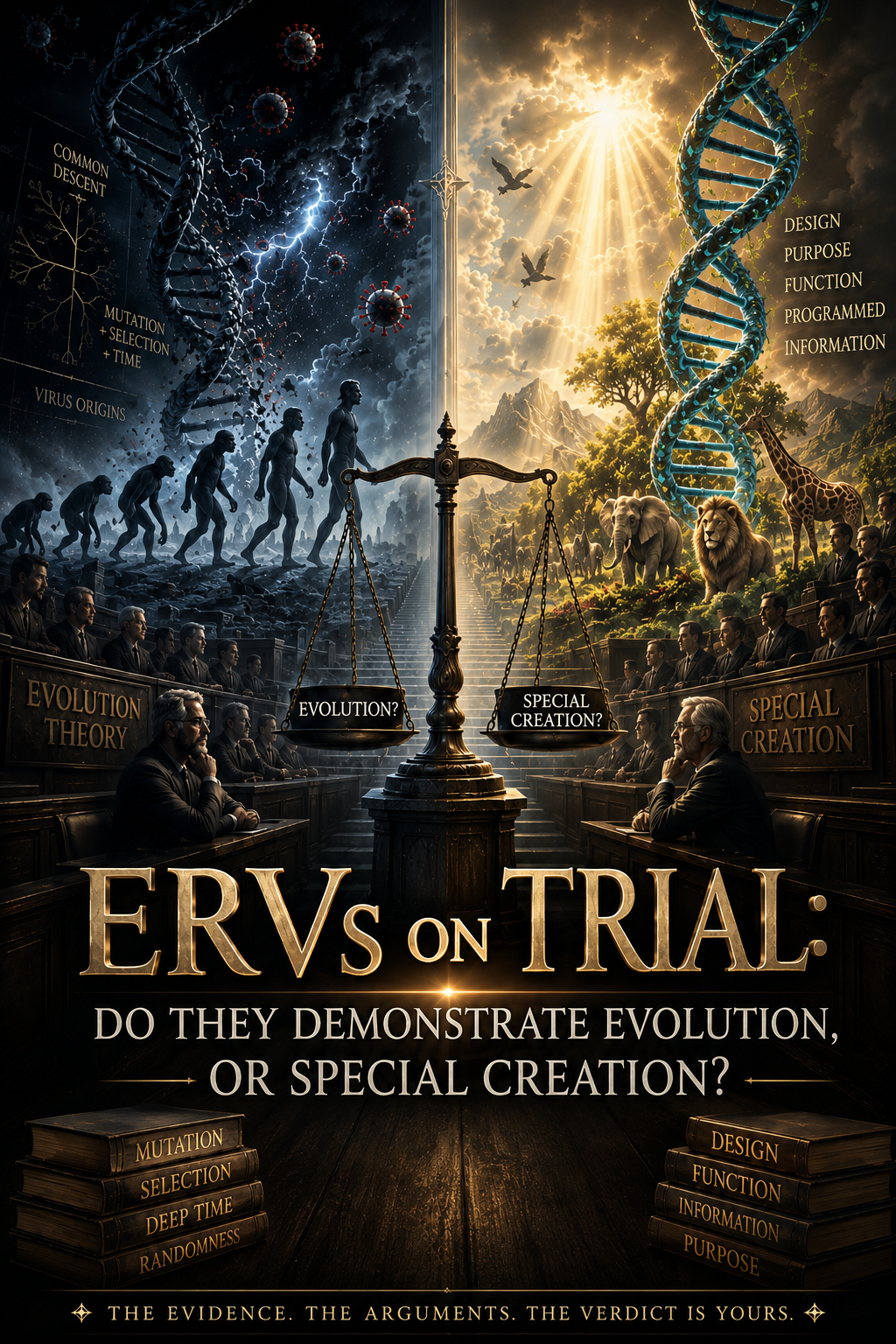
ERVs on Trial: Do They Demonstrate Evolution, or Special Creation?
- Authors
-
-
D. Budinsky
Author
-
- Abstract
-
Endogenous retroviruses (ERVs) are routinely presented as among the strongest evidence for universal common descent. On the standard account, shared ERV insertions are the fossilized scars of ancient germline infections, and their distribution in nested hierarchies across taxa is taken to be nearly decisive. In this paper I challenge that interpretation and advance a positive, design-based alternative. I distinguish two categories of ERV, fixed and unfixed, and argue that a functionally integrated subset of the fixed class comprises created genomic modules rather than degenerate viral relics, while the unfixed class reflects recent, polymorphic retroviral activity in a world subject to corruption. Drawing on the mainstream functional literature, I document that ERV-derived sequences supply enhancers and promoters, regulate the interferon response and innate immunity, help shape the p53 transcriptional network, mediate placentation through the syncytins, and confer antiviral superinfection resistance through receptor interference. Under a design framework the viral-like architecture of these elements is a functional requirement for defense and mimicry rather than a signature of viral ancestry. I develop an escape model in which exogenous retroviruses arise as corrupted derivatives of host retroelements, a direction that mainstream virology already accepts for the origin of retroviruses from LTR retrotransposons. I then meet the strongest form of the common-descent argument, the pattern of orthologous ERV insertions, on its own terms, and argue that it establishes shared genomic history rather than unguided common descent or any particular deep-time chronology. The koala retrovirus, the only documented case of retroviral endogenization observed in real time, is examined as a test case and shown to be consistent with rapid endogenization on a young timescale. I close with a set of questions the evolutionary account has not answered and situate the model within a biblical history of creation, corruption, and dispersal.
- Author Biography
- References
-
Best, S., P. Le Tissier, G. Towers, and J. P. Stoye. 1996. Positional cloning of the mouse retrovirus restriction gene Fv1. Nature 382: 826–829.
Blaise, S., N. de Parseval, L. Bénit, and T. Heidmann. 2003. Genomewide screening for fusogenic human endogenous retrovirus envelopes identifies syncytin 2, a gene conserved on primate evolution. Proceedings of the National Academy of Sciences 100: 13013–13018.
Boeke, J. D., and J. P. Stoye. 1997. Retrotransposons, endogenous retroviruses, and the evolution of retroelements. In Retroviruses, ed. J. M. Coffin, S. H. Hughes, and H. E. Varmus, 343–435. Cold Spring Harbor, NY: Cold Spring Harbor Laboratory Press.
Chuong, E. B., N. C. Elde, and C. Feschotte. 2016. Regulatory evolution of innate immunity through co-option of endogenous retroviruses. Science 351: 1083–1087.
Chuong, E. B., N. C. Elde, and C. Feschotte. 2017. Regulatory activities of transposable elements: from conflicts to benefits. Nature Reviews Genetics 18: 71–86.
Dupressoir, A., C. Vernochet, O. Bawa, F. Harper, G. Pierron, P. Opolon, and T. Heidmann. 2009. Syncytin-A knockout mice demonstrate the critical role in placentation of a fusogenic, endogenous retrovirus-derived envelope gene. Proceedings of the National Academy of Sciences 106: 12127–12132.
Feschotte, C. 2008. Transposable elements and the evolution of regulatory networks. Nature Reviews Genetics 9: 397–405.
Grow, E. J., R. A. Flynn, S. L. Chavez, N. L. Bayless, M. Wossidlo, D. J. Wesche, L. Martin, et al. 2015. Intrinsic retroviral reactivation in human preimplantation embryos and pluripotent cells. Nature 522: 221–225.
Malik, H. S., S. Henikoff, and T. H. Eickbush. 2000. Poised for contagion: evolutionary origins of the infectious abilities of invertebrate retroviruses. Genome Research 10: 1307–1318.
Mi, S., X. Lee, X. Li, G. M. Veldman, H. Finnerty, L. Racie, E. LaVallie, et al. 2000. Syncytin is a captive retroviral envelope protein involved in human placental morphogenesis. Nature 403: 785–789.
Nethe, M., B. Berkhout, and A. C. van der Kuyl. 2005. Retroviral superinfection resistance. Retrovirology 2: 52. Rebollo, R., M. T. Romanish, and D. L. Mager. 2012. Transposable elements: an abundant and natural source of
regulatory sequences for host genes. Annual Review of Genetics 46: 21–42.
Stoye, J. P. 2006. Koala retrovirus: a genome invasion in real time. Genome Biology 7: 241.
Tarlinton, R. E., J. Meers, and P. R. Young. 2006. Retroviral invasion of the koala genome. Nature 442: 79–81.
Wang, T., J. Zeng, C. B. Lowe, R. G. Sellers, S. R. Salama, M. Yang, S. M. Burgess, R. K. Brachmann, and D. Haussler. 2007. Species-specific endogenous retroviruses shape the transcriptional network of the human tumor suppressor protein p53. Proceedings of the National Academy of Sciences 104: 18613–18618.
- Cover Image
-
- Downloads
- Published
- 2026-07-07
- Section
- Articles
- Categories
Most read articles by the same author(s)
- M. Nailor, D. Budinsky, Predictions Under Trial: A Comparative Analysis of Creation and Evolutionary Predictions and Expectations , Truth in Research: Vol. 1 No. 1 (2026): Truth in Research: Foundations of Scientific Inquiry
- D. Budinsky, M. Nailor, The Hidden Clock of Humanity: A pedigree-based coalescence and fixation analysis of the human mitochondrial control region , Truth in Research: Vol. 1 No. 1 (2026): Truth in Research: Foundations of Scientific Inquiry
- D. Budinsky et al., The Carbon That Should Not Be There: Intrinsic C14 in Ancient Material? , Truth in Research: Vol. 1 No. 3 (2026): Scientific Research and Discovery
- D. Budinsky, M. Nailor, Predicted Continuity, Observed Discontinuity: Ape Y Chromosome Architecture as a Test of Bounded Diversity , Truth in Research: Vol. 1 No. 1 (2026): Truth in Research: Foundations of Scientific Inquiry
- D. Budinsky, M. Nailor, Unmasking the Genome: The End of Junk DNA , Truth in Research: Vol. 1 No. 1 (2026): Truth in Research: Foundations of Scientific Inquiry
- D. Budinsky, Are Head to Head Interstitial Telomeric Repeats Unique to Human Chromosome 2q13? , Truth in Research: Vol. 1 No. 1 (2026): Truth in Research: Foundations of Scientific Inquiry
- D. Budinsky, Does John 15 Contradict Eternal Security? , Truth in Research: Vol. 1 No. 2 (2026): Truth in Research: Theology Edition
- Bergman J., D. Budinsky, M. Nailor, Does Simple Clumping Explain the Origin of Multicellularity? , Truth in Research: Vol. 1 No. 1 (2026): Truth in Research: Foundations of Scientific Inquiry
- D. Budinsky, Australopithecines: Separate Kind, Not Transitional Form: The Australopithecine Question Answered: Design, Discontinuity, and the Biblical Model , Truth in Research: Vol. 1 No. 1 (2026): Truth in Research: Foundations of Scientific Inquiry
- D. Budinsky, The Case for Premillennialism: Why the Millennium Follows Christ’s Second Coming , Truth in Research: Vol. 1 No. 2 (2026): Truth in Research: Theology Edition